1) What are Presentation Skills?
*(Scroll down for the top 7 mistakes everyone makes)
Most people think the hardest part of presenting is standing up and speaking, which is why presentation skills are often seen as simply a matter of confidence. And yes, fear plays a role. But even when confidence isn’t the issue, many presentations still fall flat.
The real problem is what happens after.
Research on the forgetting curve shows that people can forget up to 70% of new information within 24 hours if it isn’t reinforced. So even a “good” presentation can quickly become forgotten.
That’s where most presenters get it wrong. It’s not just about speaking clearly or having polished slides. It’s about making sure your message actually lands.
Because if your audience doesn’t understand, remember, or act on what you said, the presentation didn’t work.
This is where presentation skills come in.
Presentation skills are the ability to communicate ideas clearly to an audience in a way that is easy to follow, engaging to listen to, and focused on a clear outcome. In a work setting, that outcome might be getting buy-in, influencing a decision, or helping others understand complex information.
In other words, strong presentation skills aren’t just about delivering information. They’re about making sure that information sticks and leads to action.
The most powerful person in the room is the one who can effectively communicate their ideas.”
– Barack Obama

Having taught presentation skills, received over 2,500 presentations in my life, and given over 500, learn from my mistakes and become the very best version of yourself.
Avoid these Top 7 Mistakes Everyone Makes!
- The slides are NOT the presentation, YOU are. So, be the presentation and let the slide support you. Not the other way around.
- Don’t read your slides. Add your commentary as bullet points in the notes below the slides, and print ‘Slides with notes’.
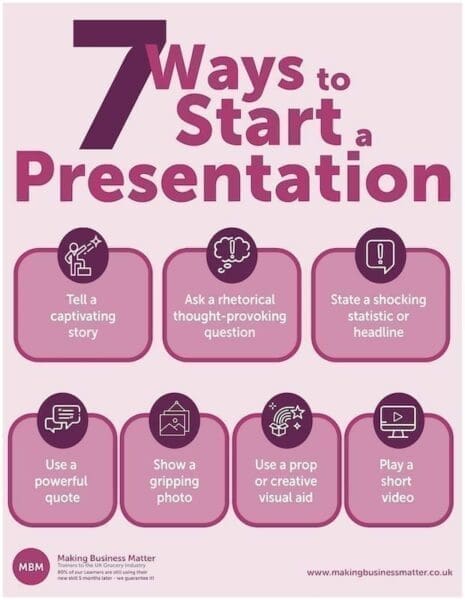
- ‘My name is Darren. Thank you…’. Weak openings will put people to sleep. Start strong with an intriguing fact or question.
- Don’t use slides. We use zero slides in our training courses. Use alternatives instead. Anything else that engages people.
- NO pauses? Put some in your presentation. Allow your audience time to digest and ask questions.
- A monotone voice will induce sleep. Vary your volume, pitch and pace to keep them engaged.
- Fact > fact > fact > etc. is like hitting your audience over the head with a bat. Tell a story instead.
This guide will show you how to do exactly that.
This Presentation Skills Ultimate Guide will cover:
- 1- What are Presentation Skills? (Above)
- 2- Public Speaking vs Presenting: Why the Difference Matters
- 3- How to Overcome Your Fear of Presenting?
- 4- What are Good Presentation Skills?
- 5- How Do I Create a Powerful Presentation?
- 6- What Medium Should You Use?
- 7- How to Improve Presentation Skills?
- 8- Further Reading and Resources
2) Public Speaking vs Presenting: Why the Difference Matters
At first glance, public speaking and presenting look the same. Both involve standing in front of an audience and communicating an idea. But in practice, they serve different purposes, and understanding that difference can immediately improve your presentation skills.
Public Speaking Inspires. Presenting Drives Action.
Public speaking is often about inspiration. It aims to connect emotionally, shift perspectives, or leave the audience feeling motivated.
Presenting, especially in a business setting, is more focused. It is designed to move people toward a specific outcome. That might be a decision, a change in direction, or agreement on a plan.
Strong presentation skills come from knowing which one you are doing before you even begin.
What This Looks Like in the Real World
A great example is Apple product launches led by Steve Jobs.
These weren’t just inspiring talks. They were carefully structured presentations designed to build understanding, create excitement, and ultimately drive action, whether that was buying a product, supporting a vision, or aligning teams internally.
What made them so effective was their intentional approach.
He would start by clearly framing the problem, often highlighting what wasn’t working in the current market. Then he introduced the solution in a simple, easy-to-follow way, focusing on just a few key ideas instead of overwhelming the audience.
He also used storytelling and repetition to reinforce his message. Key phrases and ideas were repeated throughout the presentation so they would stick. Visuals were kept simple, with minimal text, so the audience focused on him rather than reading slides.
And most importantly, everything was built toward a clear moment. Whether it was a product reveal or a key message, the presentation always led the audience to a specific takeaway or action.
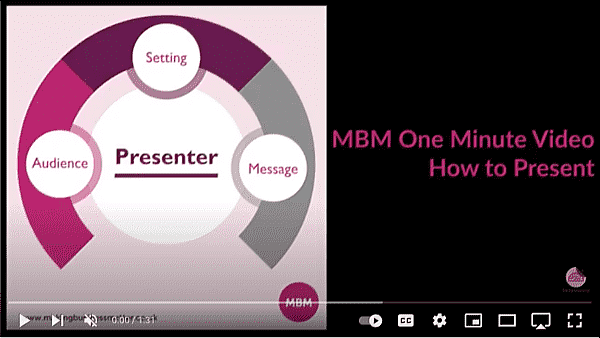
Watch our video to learn more.
What is the Importance of Presentation Skills?
In most roles today, your ability to communicate ideas clearly matters just as much as the ideas themselves. Research from 2024 consistently highlights that strong communication skills are a primary driver for leadership progression, with 93% of employers considering them essential for promotion.
You might be presenting in a formal setting, like a pitch or team meeting. Or it could be something more informal, like speaking up in a discussion or explaining your thinking on the spot. In both cases, strong presentation skills help you get your point across, build credibility, and influence how others see your ideas.
That’s why presentation skills are closely linked to career growth. The people who can explain clearly, structure their thoughts, and speak with confidence are often the ones who get heard, trusted, and given more opportunities.
But to improve these skills, it helps to understand one important distinction.
Presentation Skills vs Personal Presentation
When we talk about presentation skills, we usually think of planned moments, such as delivering a presentation, leading a meeting, or training a group. These situations give you time to prepare, structure your message, and think about how you’ll deliver it.
Personal presentation is different. It’s what happens in everyday moments when you don’t have time to prepare. Speaking up in a meeting, answering a question, or sharing an idea in a conversation. These situations rely on how clearly you can think and communicate in real time.
Both matter.
See an overview of 7 ways to start a presentation below. Click the image below for a higher resolution.
3) How to Overcome Your Fear of Presenting?
Around 75% of people report a fear of public speaking, making it one of the most common fears worldwide. You might freeze, feel nervous, or start overthinking every word you say. But the problem isn’t the fear itself. It’s how we respond to it.
One of the most useful mindset shifts is this: how you feel isn’t the same as how you perform. You can feel nervous and still come across as clear, confident, and in control.
A big reason presenting feels uncomfortable is what we can call the “spotlight effect.” When you’re in front of an audience, it feels like everyone is watching and judging you. You become overly aware of your voice, your body language, and even small mistakes. This often leads to overthinking, which makes you lose your natural flow. In reality, most people are focused on understanding your message, not analysing your every move.
Make It Practical
If you want to reduce nerves before your next presentation, focus on these three things:
- Prepare your opening well
The first 30–60 seconds matter most. If you start strong, you’ll settle quickly.
- Practice out loud
Thinking through your presentation isn’t enough. Say it out loud so your brain and voice work together.
- Keep your message simple.e
The more complex your content, the more likely you are to overthink it. Simplicity builds confidence.
>> Presentation Skills Coaching Cards <<
>> Access on Amazon <<
4) What are Good Presentation Skills?
Once you understand the basics of presenting, the next step is knowing what actually makes a presentation effective.
Strong presentation skills don’t come from one thing. They come from a combination of clarity, structure, and audience engagement. The sections below break down how to build each of these step by step.
At Amazon, teams don’t start with slides. Instead, they write a clear narrative that defines the objective and the decision needed. Meetings often begin with silent reading, ensuring everyone understands the purpose before the discussion starts.
4.1- Start With A Clear Purpose
This should start with a mind map or a simple set of questions. I like to call this ‘5 Bums on a rugby post’:

A simple way to do this is by asking key open questions:
- Who is the audience?
- What do they need to know?
- Why does this matter?
- When and where will this take place?
- How will you deliver it?
These questions help you shape your content, your message, and even your delivery style. Without this clarity, it becomes very difficult to build a focused presentation.
4.2- Define Your Objective
Your purpose sets the direction. Your objective makes it specific.
If you are unclear on what you want to achieve, your presentation will feel unfocused. A strong objective helps you decide what to include, what to remove, and how to structure your message.
For example, your goal might be to:
- Inform the audience
- Persuade them to take action
- Gain buy-in for an idea
Each of these requires a different approach. That’s why defining your objective early makes the rest of the process much easier.
When deciding upon your objective, ensure you are SMART.
4.3- Think From Different Perspectives
To strengthen your content, it helps to look at it from different angles.
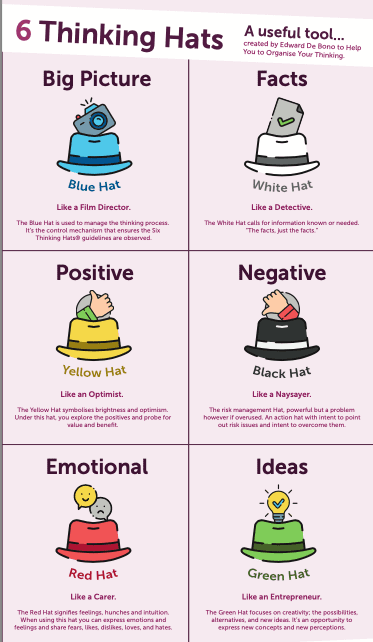
A method you could use is DeBono’s 6 Thinking Hats. Looking at your decision-making from a range of perspectives will help you think more creatively about your content:
- Red Hat: Look at the situation emotionally. What do your feelings tell you?
- White Hat: Look at the situation objectively. What are the facts?
- Yellow Hat: Use a positive perspective. Which elements of the solution will work?
- Black Hat: Use a negative perspective. Which elements of the solution won’t work?
- Green Hat: Think creatively. What are some alternative ideas?
- Blue Hat: Think broadly. What is the best overall solution?
For more, review our infographic on the 6 thinking hats. Click the image below for a higher resolution.
4.4- Structure Your Content Clearly
Once your purpose and objective are clear, the next step is organising your content.
One simple method is to create a rough storyboard. Write each key point on a separate note and move them around until the order feels logical and easy to follow.
A well-structured presentation should feel natural to the audience. They should always know where they are and what’s coming next.
At McKinsey & Company, presentations are built around a clear storyline, where each point logically builds on the previous one. This structured approach makes complex ideas easier to follow and ensures the audience can quickly understand the key message without getting lost in detail.
4.5- Ways to Engage the Audience
Now you need to think about how to grab the audience’s attention from the beginning. Ask yourself, ‘Why have they come to listen to me?’ This is normally a good place to start. Try understanding what might work for your specific audience. Ideas of ways to grab attention are:
1-Interaction:
Involve the audience directly. This could be through questions, activities, or small tasks that make them part of the presentation.
2-Tell a Story:
By starting with words like ‘imagine’, ‘think of a time’, ‘close your eyes’ or ‘what if’, you are encouraging creativity in people’s minds. Furthermore, you’re making it easier for them to relate to your topic. The story that follows needs to be relevant to the presentation to make this work.
3-Using a Quote:
By quoting someone relevant to the topic or group, you can add value and depth to your presentation.
There are only two types of speakers in the world. 1. The nervous and 2. Liars.”
– Mark Twain
4-Ask Questions:
Ask direct or rhetorical questions. Once again, this is about activating the brain and involving the audience.
5-Use a Prop or Visual Aid:
Caroline Goyder used an aid very well in her TEDx Talk. It intrigued the audience and made them pay attention to find out what it is. View her 19-minute TEDx talk below:

5) How Do I Create a Powerful Presentation?
Once you understand the core presentation skills, the next step is putting them into practice. A powerful presentation doesn’t happen by chance. It follows a clear process.
- Audience
- Voice and language
- The presenter
- Timing
- Structure
5.1- Understand Your Audience
Before building your content, think about who you are speaking to.
- What do they already know?
- What do they care about?
- Why are they listening to you?
Your presentation should be built around the audience, not just the topic. The more relevant it feels to them, the more likely they are to stay engaged and understand your message.
Below are the five different types of audiences to help you consider who you are delivering to:
Types of Audiences
- Uninformed: They know little about the topic. Focus on explaining clearly and building understanding.
- Hostile: They may disagree with you. Stay calm, find common ground, and use facts to support your points.
- Apathetic: They are not engaged. Keep it relevant and find ways to capture their interest early.
- Mixed: A combination of different views and knowledge levels. Balance facts with emotional connection.
- Favourable: They already support you. Reinforce their views and strengthen them with clear evidence.
5.2- Voice and Language
The way you communicate matters just as much as what you say.
Your choice of language should match your audience. Avoid overly technical terms, jargon, or complex phrasing if your audience is unfamiliar with the topic. If you are presenting to a diverse or international group, keep your language simple and clear so that everyone can follow.
Your voice also plays a key role in how your message is received. This includes your pace, tone, and how you emphasise key points.
A useful way to think about this is through the 5 Ps of presenting:
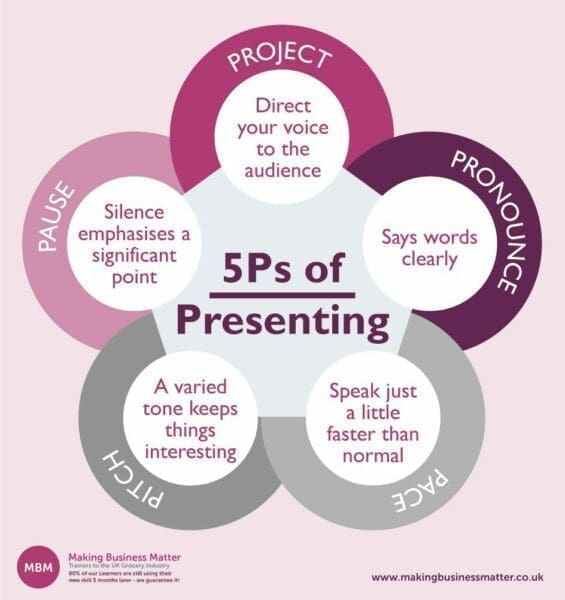
- Project: Make sure your voice reaches the audience clearly.
- Pause: Use silence to emphasise key points and give people time to think.
- Pitch: Vary your tone to keep your delivery engaging.
- Pace: Speak at a steady speed that is easy to follow.
- Pronounce: Speak clearly so your message is easy to understand.
These small adjustments can make a big difference in how your presentation is received.
5.3- The Presenter
When you present, people don’t just listen to your message. They also respond to you.
First impressions matter. Your appearance should suit your audience and environment. Beyond that, your energy and level of interest in the topic will strongly influence how people respond.
Even if you feel nervous, showing genuine interest and understanding of your topic will come across.
Body language also plays an important role. Moving with purpose, maintaining eye contact, and using gestures naturally can help reinforce your message. Avoid unnecessary movements that may distract from what you are saying.
5.4- Timing
Good timing is essential for an effective presentation.
Some presentations are short and require you to deliver your message quickly. Others are longer and require you to maintain engagement over time. In both cases, you need to manage your time carefully.
Plan how long each section should take, but stay flexible. If you notice your audience losing interest, be ready to move on or adjust your pace.
Balancing your timing ensures that your message is clear without overwhelming or losing your audience.
5.5- Structure
Structure is what makes a presentation easy to follow and remember.
A simple and effective structure includes:
- Introduction: Outline what you will cover and set expectations
- Main section: Present your key ideas, ideally focusing on no more than three main points
- Conclusion: Summarise your message and reinforce your key takeaway
- Questions: Allow time for discussion if appropriate
When your presentation is well structured, your audience can follow your thinking and stay engaged from start to finish.
Excuse the Interruption, but Here’s a Little Bit About Us…
We are the soft skills training provider, partnering with clients who are frustrated by people returning from training courses and then doing nothing differently. Our clients choose us because we achieve behavioural change through our unique training method, sticky learning ®.

Find out how to improve skills in presenting with our tailored presentation skills training.
6) What Medium Should You Use?
Once your content and structure are clear, the next step is choosing the right medium to support your presentation.
One common mistake is starting with slides too early. Tools like PowerPoint can be useful, but they should support your message, not drive it
Let’s look at a few different ways we can support our presentations:
6.1- PowerPoint Presentation (Slides, Decks)

Slides are the most common option, but they only add value when used correctly. Research shows that audiences retain significantly less information from text-heavy slides compared to presentations that use visuals and clear verbal explanations.
They work best when you need to:
- Show visuals, data, or videos
- Build information step by step
- Support key points, not repeat them
To keep slides effective:
- Keep them simple and easy to read
- Use visuals instead of heavy text
- Follow the 6×6 rule (max 6 bullets, 6 words each)
Kawasaki’s 10-20-30 Rule for Presentation Skills:
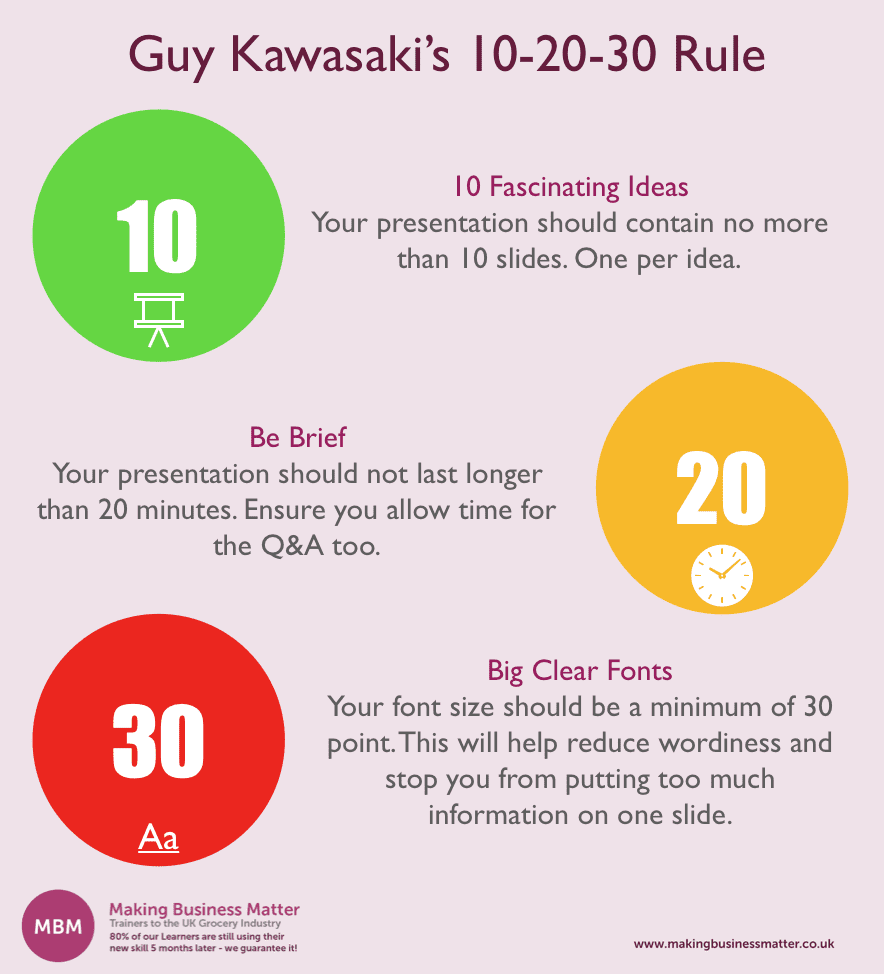
Kawasaki emphasises the importance of being succinct to be able to get your message across. We all suffer from PowerPoint regularly. Guy Kawasaki, of Apple fame, came up with a helpful and easy-to-remember rule for PowerPoint presentations. The 10-20-30 rule suggests the following for every presentation:
- Contain no more than 10 slides.
- Last no more than 20 minutes.
- Use a font size of no less than 30 points.
6.2- Flip Chart

Flip charts are great for more interactive sessions.
Use them when you want to:
- Capture ideas live
- Involve the audience
- Keep the session flexible
Avoid them if you’re not confident writing in front of others or if your presentation needs a strict structure.
6.3- Wall Boards

Wall boards can act as strong visual anchors throughout your presentation.
They work well when:
- You want visuals visible at all times
- You want people to move around and engage
- You don’t have access to slides
Just be careful they don’t distract from your main message.
6.4- Instant Audience Interaction

If you want to increase engagement, tools like Mentimeter and Kahoot! can be very effective.
- Mentimeter allows real-time voting and feedback
- Kahoot! uses quizzes to test understanding and keep energy high
Used well, these tools make your audience active participants rather than passive listeners.
6.5- Do it Alone

Sometimes, the strongest option is to present without any support.
This works best when:
- Your message is simple and clear
- The presentation is short
- You are confident in your delivery
In these cases, the focus stays entirely on you and your message.
7) How to Improve Presentation Skills?
Improving your presentation skills isn’t about learning more theory. It’s about practising the right things consistently.
A good training approach focuses on three core areas: content, delivery, and feedback.
7.1- Improve How You Build Your Content
Start by strengthening how you structure your ideas.
This includes:
- Creating a clear storyboard
- Asking questions to check audience understanding
- Using stories to make your message more relatable
- Finding simple ways to grab attention early
You can see this clearly in many talks from TED. Speakers often use simple, personal stories to explain complex ideas, making their message easier to understand and far more memorable. Instead of overwhelming the audience with information, they focus on connection.
7.2- Improve How You Deliver Your Presentation
Once your content is clear, the next step is how you deliver it.
This includes:
- Using the right tools (slides, flip charts, interactive tools)
- Practising your voice, pace, and body language
- Getting comfortable speaking in front of others
At companies like Google, employees regularly practise presenting in small groups as part of internal learning programs. The focus isn’t perfection. It’s repetition and confidence through doing.
7.3- Use Feedback to Improve Faster
This is where most people make the biggest progress.
A simple system you can use:
- Record yourself presenting
- Watch it back
- Get feedback from others
- Improve one thing at a time
This approach is widely used in professional training environments because it makes improvement measurable and consistent.
7.4- Practice in a Realistic Setting
One reason structured training works well is that it creates space to practise in real conditions.
Many presentation skills courses are split over two days. This allows you to:
- Learn key techniques
- Apply them in a real presentation
- Receive feedback
- Improve and present again
That second round of practice is where real improvement happens. It turns knowledge into a skill you can actually use.
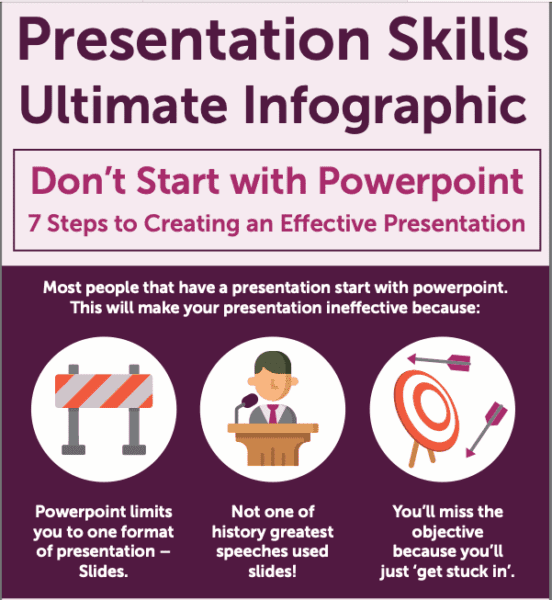
Take a look at our presentation skills infographic below and find out how to improve your presentation skills.
Click the image for a higher resolution:
Final Thoughts
Thinking back to my early days of speaking in front of a class, I was terrified. I struggled with eye contact and couldn’t project my voice clearly. Even simple presentations felt uncomfortable.
When I moved into business, I knew I had to improve. So I took a sink-or-swim approach. I stepped into an opportunity to train a group of nine people over five weeks. At the start, it wasn’t easy. For the first week, I was nervous, uncomfortable, and very aware of every mistake.
But with consistent practice, things began to change. Speaking became more natural, my confidence improved, and I started to focus more on the message than on myself.
Today, I run a training business and deliver presentations to groups of all sizes across different organisations. That progress didn’t come from talent. It came from repetition.
Like any skill, presentation skills improve the more you practise them.
This Skill Will Change Your Life – It Has Mine
Skills for giving effective presentations are so important for helping us move through life, gaining the best opportunities, and showing the best of ourselves. Even if you don’t regularly need to talk in front of groups, it is a skill that will help in many aspects of your work and personal life.
From feeling more confident to being ready to say ‘yes’ when the opportunity presents itself, these skills will help you grow. Knowing how to give a good presentation and having good communication skills should be life skills that everyone develops. In the wise words of Richard Branson:
If somebody offers you an amazing opportunity but you are not sure you can do it, say yes – then learn how to do it later!”
You need to be ready to have the conversation and put yourself forward.
8) Further Reading and Resources on Presentation Skills
You can find further insight, detailed definitions, and clarification of all the key relevant terms mentioned in this guide in our Glossary for giving good presentations.
8.1- Quotes
‘No audience ever complained about a presentation or speech being too short.’ – Stephen Keague
‘[The] best way to conquer stage fright is to know what you’re talking about.’ – Michael H Mescon
8.2- Books All About Presentation Skills
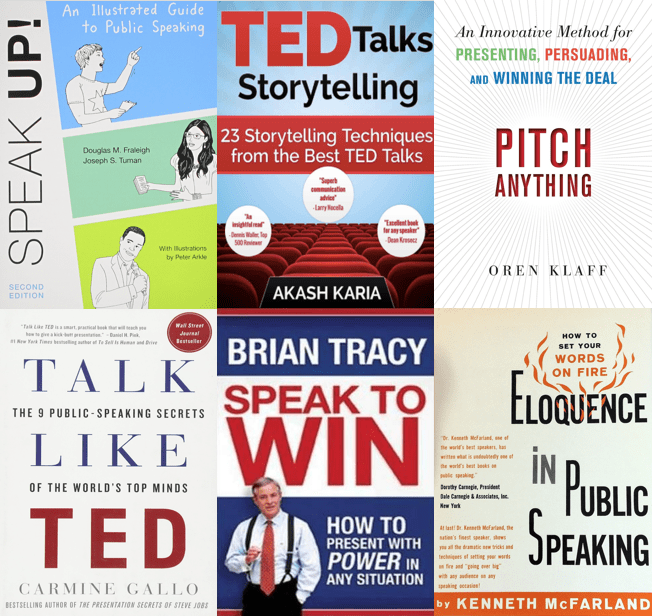
So many amazing authors and speakers have given their tips on presenting and dealing with nerves. I have included my favourite books below:
- ‘Speak Up!: An Illustrated Guide to Public Speaking‘ by Douglas M Fraleigh and Joseph S. Tuman. This is an illustrated introduction to public speaking and presentations.
- ‘TED Talks Storytelling: 23 Storytelling Techniques from the Best TED Talks’ by Akash Karia. This will give you an insight into how to best use stories to engage your audience.
- ‘Pitch Anything: An Innovative Method for Presenting, Persuading, and Winning the Deal’ by Oren Klaff. An Investment banker, now an author with over $400 million won in deals, shares his secret winning formula.
- ‘Talk Like TED: The 9 Public-Speaking Secrets of the World’s Top Minds’ by Carmine Gallo. All the research shows the 9 points that make any presentation successful.
- ‘Speak to Win: How to Present with Power in Any Situation’ by Brian Tracy. This is a book of solid advice for newcomers to the world of presenting.
- ‘Eloquence In Public Speaking’ by Dr Kenneth McFarland. This is a dated book,k but the lessons learned are so relevant and well-taught that it is well worth a read.
8.3- Presentation Skills Free Download
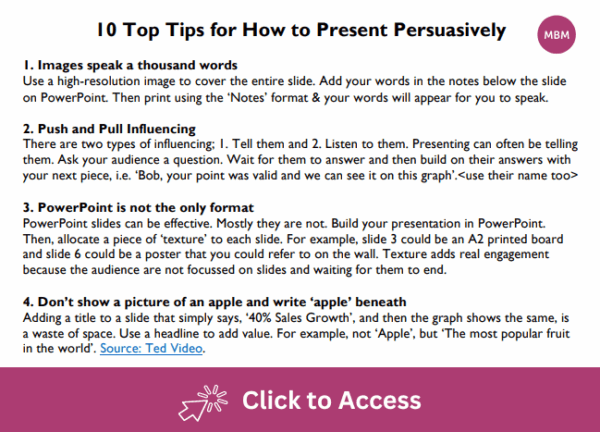
Click the image to access our ’10 Top Tips for How to Present Persuasively’:
8.4- Must-watch Presentation Skills Videos:
Watch our playlist from our YouTube channel for effective presentation skills tips. Click the video below:
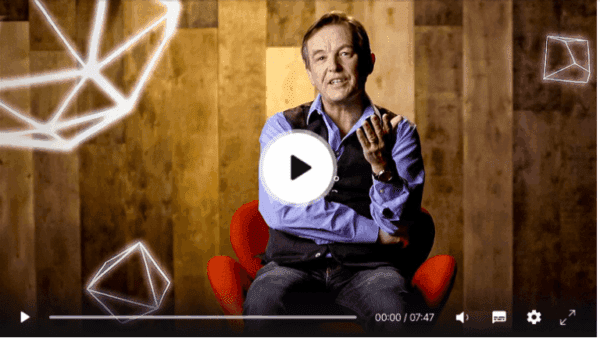
Chris Anderson, a TED Talks presentation skills curator, explains the secret to a TED Talk. The ability to place an idea or thought in a listener’s mind. It’s a very interesting concept:
We also have a range of bite-sized 60-second Presentation Skills Clips on YouTube:
- Master Presentations INSTANTLY with Teams Speaker Coach!
- Beat PRESENTATION Jitters with THIS Simple Trick!
- Make Your PRESENTATIONS POP Using THIS TIP!
- INSTANTLY Boost Engagement With THESE Presentation Tips!
- START Your Presentation Like a PRO! Top 3 Engaging Presentation Starters
- Kill THIS Boring Presentation Habit NOW!
- Give GREAT PRESENTATIONS with the Pyramid Principle!
8.5- Relevant Presentation Skills Articles You May Like:
- Presentation skills examples.
- Must-know presentation tricks.
- All about virtual presentations.
- Here’s how to start presenting with impact.
8.6- Contact Us
Lastly, feel free to get in touch to find out how our presentation training can help you. Simply visit our contact us page or email us at helpme@makingbusinessmatter.co.uk, and we will be happy to get back to you.
Remember, you are the presentation, not the slides.
– Darren A. Smith.