

Why Most Leaders Break Under Pressure (And Why It’s Predictable)
Pressure is not rare in business. It shows up every day in deadlines, difficult clients, tight budgets, and fast decisions. Yet when leaders struggle in these moments, we act surprised. We talk about resilience. We talk about mindset. We talk about whether someone is “cut out” for leadership. But don’t talk about mental preparation.
The data tells a different story.
85% of business leaders have experienced decision distress, according to a study reported in business research summaries. That is not a small group. That is most leaders. And it raises an uncomfortable question: if so many people fail under pressure, is the problem really the people?
Here is the part most organisations avoid. Pressure in business is predictable. We know deadlines will tighten. We know conflict will happen. We know information will be missing when big calls need to be made. None of this is unexpected. Yet leaders are still sent into these moments with no preparation beyond “do your best.”
When things go wrong, the story changes quickly. A slow decision becomes a confidence issue. A strong emotional response becomes a personality flaw. A tense meeting becomes proof that someone cannot handle pressure. Blaming the individual feels easier than questioning the system that put them there.
But this logic does not hold up.
Mental preparation in business is not about staying calm or thinking positive thoughts. It is about being ready before pressure hits. It means knowing how decisions will be made when time is short. It means expecting tension instead of being shocked by it. It means having a plan for how to think and act when situations get uncomfortable.
Here is the hard truth that many leaders learn too late. People do not “rise to the occasion” in high-pressure moments. They fall back on whatever preparation they were given. If there were none, the cracks are guaranteed to show.
When leaders break under pressure, it is rarely a personal failure. It is a predictable outcome of sending people into pressure unprepared.
Mental Preparation Means Preparing for Decisions, Not Feelings

Many people hear “mental preparation” and think about emotions. Staying calm. Managing stress. Keeping a positive mindset. In business, that focus misses the real problem. Most failures under pressure are not emotional. They are decision failures.
Mental preparation at work is about decision readiness. It is about knowing how choices will be made when time is short, information is unclear, and stakes are high.
Pressure Does Not Create Problems. It Reveals Them.
When things are calm, teams often look aligned. Everyone agrees. Conversations are polite. Then pressure hits, and everything changes.
Decisions slow down. Meetings drag on. People talk over each other or go quiet. Suddenly, no one is sure who has the final say. What looks like stress or conflict is usually something simpler: no clear decision structure.
Pressure does not create confusion. It exposes it.
Why Decision Clarity Matters More Than Emotional Control
Under pressure, unclear decision rules create hesitation. Leaders pause not because they are unsure of the answer, but because they are unsure of their authority. Team members push back, not because they are emotional, but because roles were never clear.
Teams that prepare for decisions ahead of time avoid this trap. They spend less time debating power and more time acting.
A Simple Business Example That Works
Teams that clearly define decision ownership at the start of a project move faster and fight less later.
They know:
- Who makes the final call
- When input is welcome
- When speed matters more than agreement
When urgency shows up, there is no confusion. There is no hidden tension. The team already knows how decisions work. Stress does not take over because the system holds.
Unprepared teams experience the opposite. Pressure turns small disagreements into big ones. Meetings feel tense. Strong opinions feel personal. What looks like an emotional problem is really a decision-design problem.
Our Sticky Learning ® method is 7x more effective than 1-day training courses. Plus, we deliver a Chain of Evidence report proving your Return on Investment. Discover Soft Skills Training that changes behaviours long-term.

What Leaders Should Do Before Pressure Hits
First, define decision authority early. Be specific. Avoid vague phrases like “we’ll figure it out” or “we decide together.” Say who decides when time runs out.
Second, agree on behaviour before disagreement happens. Set clear expectations for challenge and debate. This prevents emotional noise when opinions clash.
Finally, remove ambiguity wherever possible. Unclear roles, goals, and ownership always get worse under stress. Cleaning this up in advance is one of the most effective forms of mental preparation.
Mental preparation is not about helping people feel better under pressure. It is about helping them decide better when pressure is unavoidable.
Why Aviation Reduced Human Error (And What Businesses Can Learn)

For years, aviation accidents were blamed on individual failure. Someone missed something. Someone froze. Someone made a bad call. Over time, this explanation stopped making sense. The people involved were not careless or untrained. They were experienced professionals operating under intense pressure.
What investigations uncovered was more subtle and more human. Stress narrowed attention. Hierarchy discouraged questions. Silence felt safer than challenge. The problem was not knowledge. It was what happened to behaviour when the stakes were high.
What Aviation Changed Under Pressure
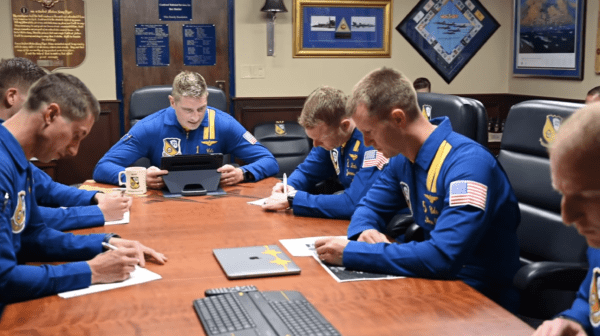
Instead of demanding stronger people, aviation redesigned the system. Through Crew Resource Management, teams began preparing for pressure before it arrived.
Checklists reduced mental overload, but the deeper shift was cultural. Speaking up became an expectation, not an act of bravery. Teams rehearsed stressful scenarios, so responses became familiar. Pressure was no longer treated as an exception; it was now a standard. The Blue Angels pre-flight briefing room at NAS Pensacola on July 7, 2021, as the pilots prepare for a practice flight, is a great example of mental training before an important event. The pilot’s “chair fly” during the brief to simulate manoeuvres done airborne.
Why This Matters in Business
The same dynamics play out in workplaces every day. In high-pressure meetings, junior employees hesitate to raise concerns. Strong personalities dominate the room. Risks are softened or delayed to avoid conflict. When problems surface later, leaders ask why no one flagged them earlier.
The honest answer is usually simple. The system never made it normal to do so.
Silence at work is rarely about fear alone. It is about unclear expectations under pressure.
What Leaders Can Copy Right Now
Leaders do not need aviation manuals to apply this lesson. Small changes in preparation can shift behaviour quickly.
- Pre-brief key moments
- Before critical meetings or decisions, name where pressure or disagreement may show up
- Define speaking up as part of the role
- Make it clear that raising concerns is expected, not risky
- Lower the emotional cost of challenge
- Treat questions and pushback as input, not resistance
- Signal safety through action
How you respond to the first challenge sets the tone for everyone else. Aviation succeeded because it accepted a hard truth. Pressure changes how people behave. Businesses that design for that reality get clearer signals, stronger decisions, and fewer surprises when it matters most.
NASA and Training for Failure Before It Happens

NASA assumes things will go wrong. Failure is not treated as a surprise. It is treated as a possibility that must be prepared for. That mindset shapes everything they do.
Teams do not just rehearse ideal missions. They run simulations that are designed to fail. Systems break. Data disappears. Signals conflict. The goal is not to stay confident. The goal is to learn how to think when conditions are imperfect.
This approach forces teams to practice decision-making when clarity is missing. That is where real pressure lives.
What NASA Does Differently Under Pressure
Through repeated simulations, teams get used to uncertainty. They learn how to prioritise when information is incomplete. They learn when to act and when to pause. They learn how to stay aligned even when the situation is unclear.
What matters most is this: NASA prepares people for judgment, not certainty. Confidence is useless if it depends on perfect conditions. Prepared judgment works even when things go wrong.
Why This Matters in Business
Business pressure rarely comes with clean data. Deadlines move faster than analysis. Market signals conflict. Decisions must be made before all the answers are known.
Yet many teams only prepare for best-case scenarios. Plans look great on paper but collapse when assumptions break. When that happens, leaders hesitate. Teams argue. Execution slows down.
The problem is not skill. It is a lack of rehearsal for uncertainty.
What Leaders and Teams Should Do
You do not need NASA-level simulations to apply this thinking. You need better questions before launch.
Here are simple ways to borrow the approach:
- Rehearse failure, not just success
- Ask what could realistically go wrong, not what looks good in slides
- Practice decisions with missing information
- Run short scenarios where teams must act without full data
- Ask “what breaks first?” before execution
- This focuses attention on weak points early, when they are easier to fix
- Agree on decision priorities in advance
- Speed, safety, cost, or quality. Pressure forces trade-offs. Decide which one wins before you need to choose
NASA does not aim to eliminate uncertainty. It prepares teams to operate inside it. Businesses that want better outcomes under pressure should do the same.
What Sport Gets Right About Mental Preparation (And Business Doesn’t)

Elite athletes don’t wait to see how they’ll handle pressure. They prepare for it in advance. Mental preparation is part of training, not something saved for after things go wrong.
Take Cristiano Ronaldo. Before major matches and high-stakes moments, his preparation is deliberate. Visualization. Repetition. Routine. He doesn’t hope he will perform well under pressure. He expects pressure and prepares his response to it.

Visualisation in alpine skiing is another example. By vividly imagining yourself executing movements, navigating terrain and achieving success on the ski course, you can effectively train your mind and body for peak performance. Visualisation isn’t about guaranteeing success but rather preparing mentally and increasing the likelihood of achieving desired outcomes. Alex Mooney is an alpine skier who uses this technique to ensure his muscle responses are quick and precise during competitions.
That mindset is standard in sport. It’s strangely rare in business.
In business, leaders walk into negotiations, difficult conversations, or big decisions with no mental preparation at all. They prepare slides, numbers, and arguments, but not how they’ll think or react once tension rises. When pressure hits, hesitation or emotion is treated as weakness instead of a predictable human response.
Athletes understand something business often ignores. Pressure doesn’t bring out your best. It brings out what you prepared. Mental preparation isn’t about confidence or motivation. It’s about reducing surprise and making performance more reliable when the stakes are high.
A footballer wouldn’t step up to a penalty without mental rehearsal. Yet business leaders step into critical moments every day without any mental preparation, then judge themselves or others for how those moments unfold.
That gap, more than talent or intelligence, explains why pressure breaks so many capable people at work.
The Most Useful Mental Preparation Habit Leaders Can Build

Most leadership advice asks people to change how they feel under pressure. That is hard to do in the moment and unrealistic during a busy workday. Strong leaders do something simpler and far more reliable. They prepare before pressure shows up.
This is where one habit makes a real difference.
If there is one place where mental preparation actually changes performance, it is before pressure shows up. Most leaders think mental preparation happens in the moment, when stress is already high. That is usually too late. Effective mental preparation happens earlier, when thinking is still clear.