
The Practical Guide to Net Revenue Management: How FMCG Brands Really Grow
Growth in the FMCG sector isn’t just challenging, it’s becoming increasingly difficult every year. Research from NielsenIQ shows that 85% of new product launches fail within three years, and BCG reports that almost two-thirds of revenue growth for the top 50 FMCG companies now comes from pricing and mix, not volume. In other words, selling more units is no longer the main path to growth. How you price, promote, and structure your offering has become far more important in net revenue management.
This shift is one of the reasons Net Revenue Management (NRM) has become such a critical capability for consumer goods companies. Whether you call it revenue management, revenue growth management, yield management, or simply price and promotion optimisation, the goal is the same: use data to make smarter decisions that improve both sales and profit.
As more FMCG companies turn to NRM, the big question becomes:
Is it just another trend, or is it the foundation for profitable growth in the years ahead?
To answer that, this article breaks down what NRM really is, how it works, and how companies across different industries are using it to drive results.
What Is Net Revenue Management (NRM)?
Net Revenue Management, often shortened to NRM or RGM (Revenue Growth Management), is a structured, data-driven approach to maximising profitable growth. The formal definition from Wikipedia describes revenue management as:
“The application of disciplined analytics that predict consumer behaviour and optimise product availability and price to maximise revenue growth.”
In simpler terms, Net Revenue Management is about understanding how shoppers behave and then adjusting price, promotions, pack sizes, product mix, and trade spend to grow both sales and profit.
This is why many FMCG teams describe NRM as an evolution of Category Management; both use data to understand shopper needs, but NRM goes further by connecting those insights directly to financial outcomes.
To break it down:
-
Net → What remains after all deductions (discounts, trade spend, costs).
-
Revenue → The income generated from selling products.
-
Management → Using processes, controls, and decisions to improve results.
Put together, NRM is the discipline of managing the drivers of revenue so the business earns more profit from every unit it sells.
If you remember one line, it should be this:
NRM = Optimising Price, Promotions, Range, Placement, and Trade Spend.
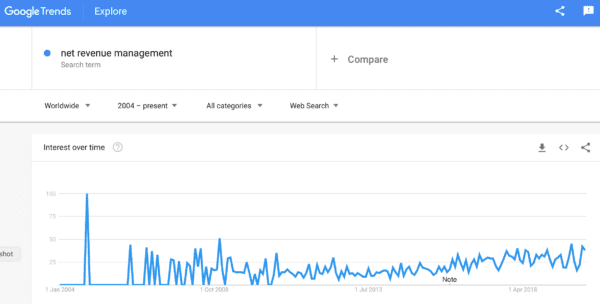
The graph below utilises google’s trend tool. This tool shows how many searches there are on google for any given term, over time. For net revenue management, you can see that since 2018 the number of searches has doubled.
Why Is NRM Suddenly Trending?
Net revenue management isn’t new; airlines and hotels have used yield management for decades, but its rapid rise in FMCG is no coincidence. The market is changing, and companies are being forced to rethink how they grow.
Here’s why:
1. Volume growth is slowing across the industry.
BCG reports that nearly two-thirds of FMCG revenue growth now comes from price and mix, not selling more units. This means pricing and portfolio decisions matter more than ever.
Our Sticky Learning ® method is 7x more effective than 1-day training courses. Plus, we deliver a Chain of Evidence report proving your Return on Investment. Discover Soft Skills Training that changes behaviours long-term.

2. Shopper behaviour is shifting.
Consumers are trading down, switching brands more easily, and reacting strongly to promotions. Net revenue management helps companies understand these shifts instead of guessing.
3. Inflation and cost pressures are squeezing margins.
Raw material, labour, and logistics costs continue to rise. Net revenue management gives companies a way to protect profitability without losing shoppers.
4. Trade promotions are becoming less effective.
NielsenIQ found that 72% of FMCG promotions fail to break even. This is pushing companies to re-evaluate their entire promotional strategy.
5. Data availability has exploded.
Retailer loyalty cards, EPOS data, shopper panels, and digital behaviour now provide an enormous amount of insight. Net revenue management simply helps businesses make sense of it all.
Because of these pressures, in the Image below, you can see that Google Trends shows interest in “Net Revenue Management” doubling since 2018, a sign that more manufacturers and retailers are turning to NRM for answers.
Why NRM Works: The Airline & Hotel Blueprint
Most people think the Net Revenue Management framework started in supermarkets, but the idea actually came from airlines. Airlines have a tough problem: they have a limited number of seats, and once a plane takes off, any empty seat becomes lost money forever. So they had to learn how to use data to make every seat count.
How American Airlines Started It
American Airlines was one of the first companies to do this well. Their chairman, Robert Crandall, created something called yield management. It sounds complicated, but the idea is simple:
-
Predict how many people want to fly
-
Change prices based on demand
-
Save some seats for customers who are willing to pay more
When they used this approach, they increased revenue by 14.5% without adding a single new plane. That’s the power of using data instead of guessing.
Hotels Took the Same Idea
Hotels quickly copied airlines. Marriott, for example, used data to change room prices depending on:
-
How full the hotel was
-
The day of the week
-
Local events
-
How far in advance were people booking
By doing this, they added $175 million in extra revenue. Again, no new rooms — just smarter decisions.

Why This Matters for FMCG
Now think about your products the same way airlines think about seats.
Airlines learned three big lessons:
-
Not all seats are equal.
Some seats earn more money than others. -
Not all customers are equal.
Some pay full price, some only buy discounts. -
Data beats guessing.
If you know what people want, you can make better decisions.
FMCG companies face the same challenges.
Here’s how the lessons transfer:
1. Some products are more important than others.
Just like a business-class seat brings in more revenue, some SKUs drive most of your profit.
These are your hero SKUs, the products that shoppers expect every time.
Example:
If a shopper can’t find Tabasco sauce, they probably won’t choose a substitute. So that product must have almost 100% availability.
2. Not all promotions are good promotions.
Airlines know when to drop prices and when to keep them high. FMCG companies need the same clarity. Some promotions bring in new shoppers. Others only encourage people to stock up and buy less later. Net Revenue Management helps you see the difference.
3. Different shoppers behave in different ways.
Just like airlines have business travellers and bargain hunters, you have:
-
Heavy users
-
Light users
-
Price-sensitive shoppers
-
Loyal shoppers
-
Impulse buyers
Net Revenue Management helps you understand these groups so you can match the right price and promotion to the right people.
How Do We Calculate Revenue?
Revenue is simply the money a business earns from selling its products or services. The formula is very straightforward:
Revenue = Units Sold x Sales Price
For example, imagine you run a hotel with 100 rooms. Last week, you sold all 100 rooms at an average price of £50.
Your revenue would be:
100 rooms × £50 = £5,000
That part is easy.
The hard part is increasing this number week after week, because you can’t suddenly add more rooms. You only have 100. Airlines face the same challenge: once the seats are gone, they’re gone.
So if you can’t sell more rooms, the only way to grow revenue is to be smarter about how you price them.
This is where Net revenue management comes in.
Instead of selling every room for the same price, the hotel might use data to adjust prices based on demand. For example:
-
Early bookings might be £65
-
Low-demand days might be £48
-
Last-minute rooms might again be £65
When you average these different prices together, the hotel earns more than £50 per room, even though it still sells only 100 rooms. No extra rooms needed, just smarter pricing.
Net revenue management applies this same idea to FMCG. By adjusting prices, promotions, and pack sizes based on real shopper behaviour, companies increase revenue without needing to sell a lot more units. It’s about getting more value from what you already have.
Net Revenue Management Case Studies
NRM isn’t just a theory. Big brands use it every day to make smarter decisions and grow profit. Here are three clear examples:
1- Diageo
Diageo wanted to improve how it priced and promoted its drinks across Europe. They brought in a full NRM program and used data to understand which products and promotions truly added value.
What changed:
-
They improved their price and mix, earning more from premium products
-
They focused on premiumisation, choosing stronger assortments for key markets
-
They cut back on promotions that didn’t make money
The result?
Their CFO later said Net revenue management became one of the biggest drivers of margin growth for the company.
2- Danone
Danone looked at its yoghurt portfolio in France and realised something wasn’t working. When they dug into the data, they found:
-
40% of promotions were losing money
-
Shoppers were trading down to cheaper products more often than expected
-
Some smaller pack sizes were priced too low, hurting margins
Using NRM, they redesigned their pricing and promotional plan.
What improved:
-
Promotion ROI jumped by double digits
-
Cutting low-value SKUs made production and logistics more efficient
-
A clearer “good-better-best” pricing ladder protected premium products
Net revenue management helped Danone stop guessing and start managing its range with purpose.
3- P&G
P&G used Net revenue management pillars to rethink how they priced and positioned several of their categories. Instead of having one flat pricing strategy, they created a clearer good-better-best structure across brands and pack sizes.
What happened next:
-
Premium products gained more share
-
Retailer relationships improved because pricing felt more consistent
-
They reduced their reliance on deep promotions to drive volume
P&G proved that a strong pricing architecture can grow revenue without needing constant discounts.
What is Revenue Optimisation?
This 2-minute video from Nielsen provides a great answer:
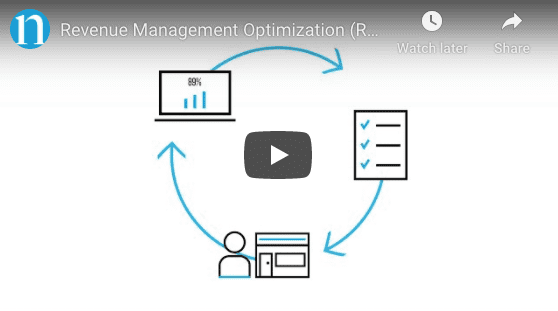
The key takeout is that 72% of trade spend does not break even!
Additional key take-outs from Nielsen’s article on Revenue Management Optimisation.
- Consumer product companies spend extensively on trade promotions, to the tune of $1 trillion each year. The disappointing part is that about 40 per cent of that spending doesn’t drive the desired results.
- After all, companies spend more of their marketing budgets on trade promotion than on anything else. But with so many moving parts involved, it’s not surprising that companies often build a series of disjointed roads rather than a unified highway.
- Strategic planning: Make more confident annual price and promotion strategies based on extensive scenario planning, using forward-looking analytics to drive on-point promotion strategies and execution-oriented sales plans.
- Tactical planning: Deliver execution-oriented sales plans aligned to your greatest opportunities and verified through event-level scenario planning and forward-looking analytics.
- Ongoing retail execution: Monitor trade promotion performance in real-time to maximise retail promotion compliance, product distribution and inventory availability.
- Post-event analytics: Perform comprehensive profit and loss analyses after each event to guide future program decisions.
- Trade spending has doubled over the past 10 years, at the expense of profits, and is now more than twice that of ad spending.
The Margin Waterfall: Where Profit Actually Disappears
One of the most eye-opening tools in Net revenue management is the margin waterfall.
It shows, step by step, how your revenue gets chipped away as a product moves from the price you intend to sell it for to the profit you actually keep.
Think of it as watching your money “drip” down a waterfall; each stage takes a little more away.
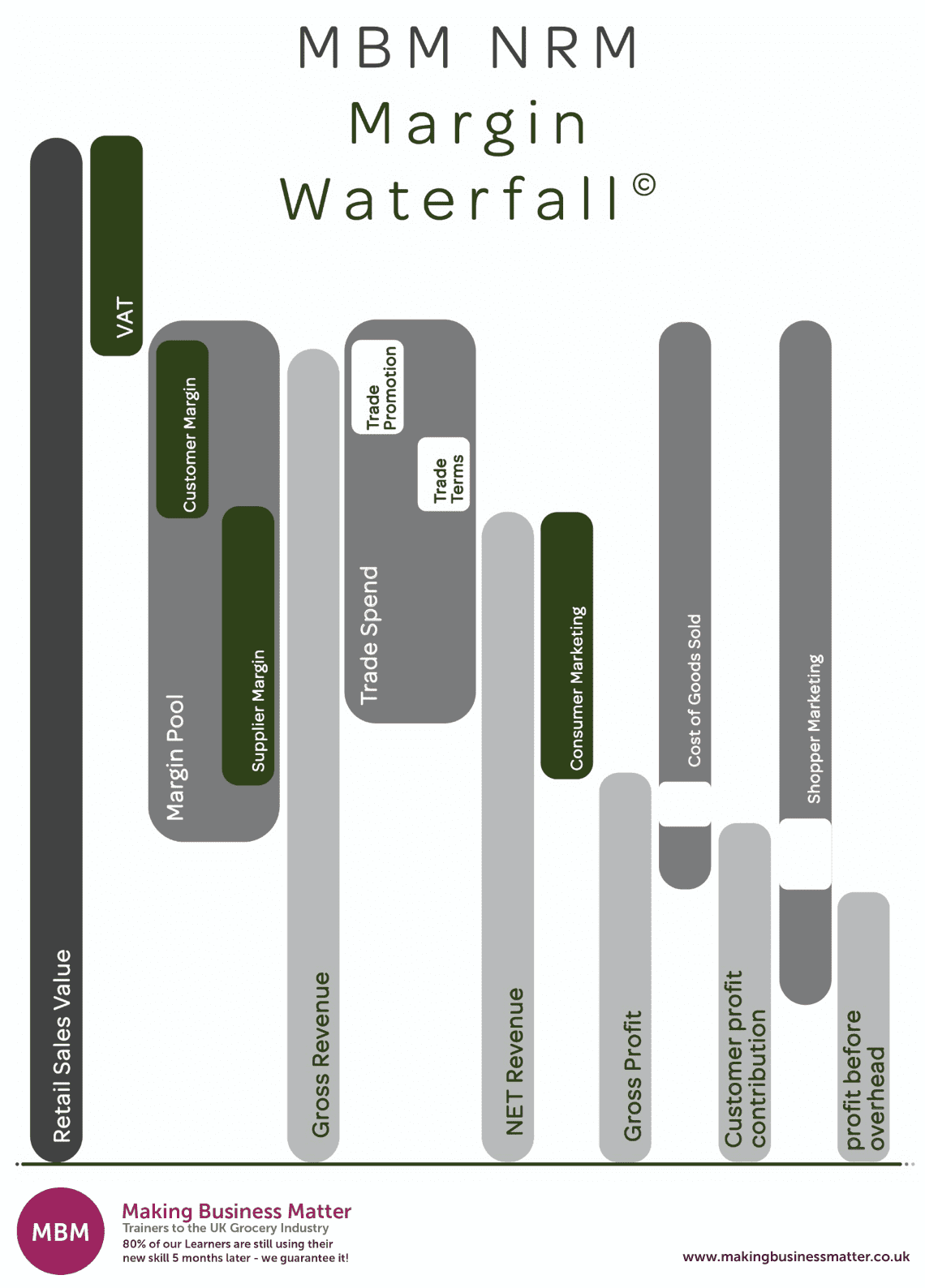
Here’s how it works.
The Margin Waterfall, Step by Step
-
List Price
The price you wish the product would sell for.
(This is the starting point and usually the highest number.) -
Invoice Price
After standard retailer discounts and terms, the price drops. -
Off-Invoice Discounts
Extra discounts for volume, new launches, or retailer deals. -
Trade Spend
Money paid to retailers to secure promotions or visibility. -
Promotional Funding
Deep cuts during promotions are often the biggest hit to margin. -
Logistics Costs
Transport, warehousing, and handling fees. -
Retailer Margins
What the retailer keeps on top of everything else. -
Final Profit
What’s left is often far less than expected.
How NRM Helps
NRM gives teams visibility into every stage of this waterfall so they can answer questions like:
-
Which discounts are worth keeping?
-
Which promotions destroy profit?
-
Which SKUs look strong in volume but weak in margin?
-
Where are we leaking money without realising it?
With a clear waterfall, leaders can stop “blanket promotions” and start focusing on activities that actually build margin, not destroy it.
What Does an Effective NRM Model Look Like
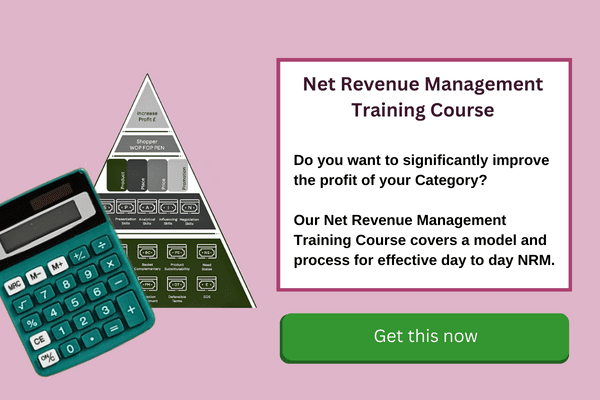
NRM can feel abstract until you see how all the elements work together. A helpful way to understand it is through the NRM Pyramid, which shows the structure behind every successful revenue management strategy. Each layer plays a different role, and together they guide a business from insights to real profit growth.
At the very top sits the ultimate goal of any commercial organisation: Increasing Profit.
Everything else in the pyramid exists to support that outcome.
1. Profit: The Outcome Every Company Wants
The goal of NRM is simple. A company wants to grow profit in a smarter and more predictable way. Every decision in the model should ultimately support this outcome.
2. Shopper Behaviour: WOP, FOP and PEN
Beneath the profit layer is the foundation of all category growth, which is the shopper. Although companies track many metrics, shoppers only grow a category in three ways.
Weight of Purchase (WOP)
This answers the question: How much does a shopper buy in one trip?
Shoppers buy more per trip. For example, a two-plus-one free promotion encourages a larger basket.
Frequency of Purchase (FOP)
This answers the question: How often does a shopper return to buy from the category?
Shoppers buy more often. A winter price drop on ice cream can bring a shopper back sooner than usual.
Penetration (PEN)
This answers a bigger question: How many people buy the category at all?
New shoppers enter the category. A small trial pack or a simple recipe can attract people who never bought the category before.
Understanding these three levers helps companies avoid making decisions that look good numerically but do not change real shopper behaviour.
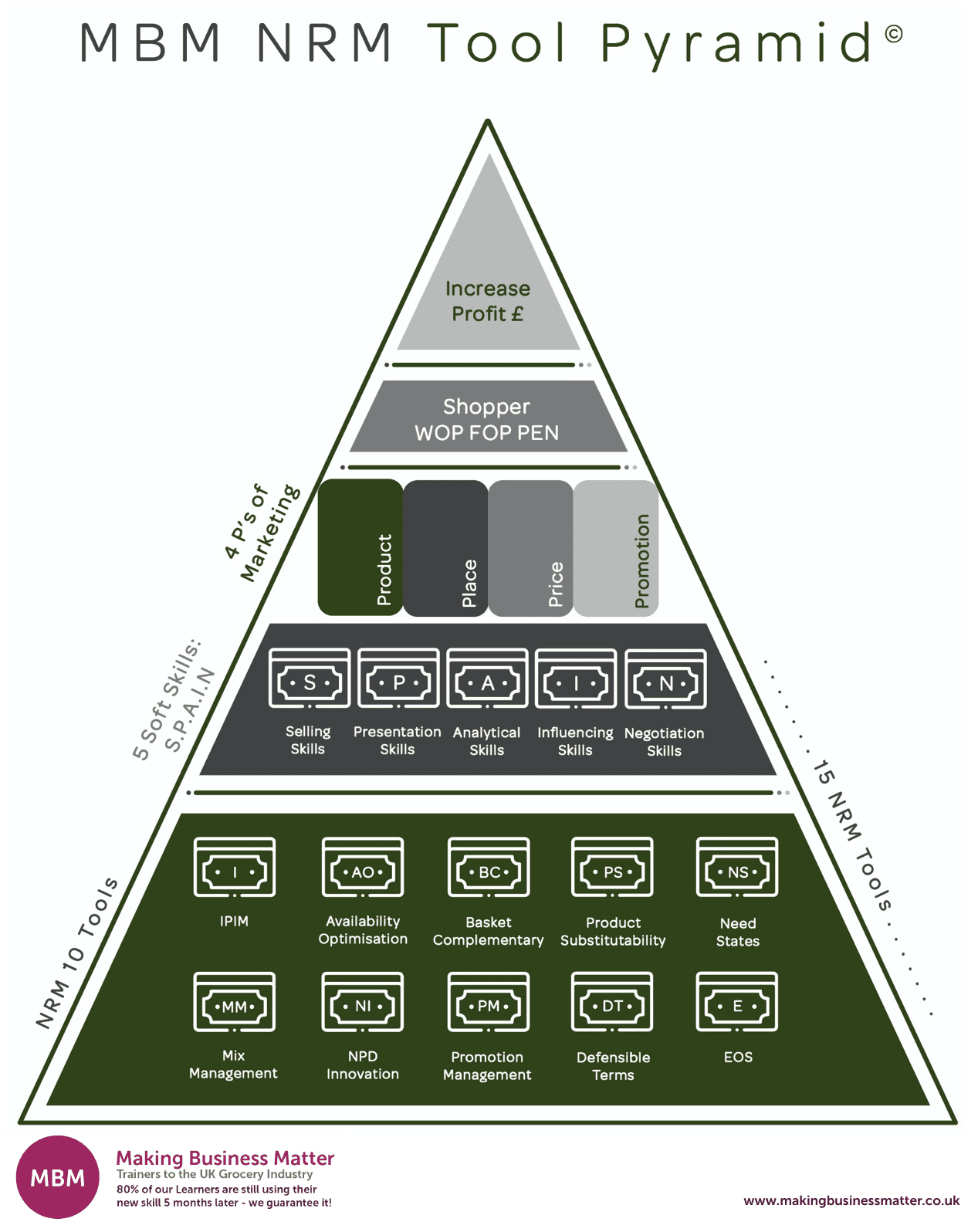
3. 4 P’s of Marketing
The 4 P’s of marketing help us to choose a strategy to focus on: Product, Place, Price and Promotion. This might be improved further to be RAPPP: Range, Availability, Price, Placement, and Promotions. Similar. Maybe this term is more easily understood by Category Managers.
4. S.P.A.I.N.
In the next row, we see ‘SPAIN’. The soft skills are key to making it all happen. Without the ‘people’ element, nothing will happen. As Jack Ma, the Chairman of Alibaba said, ‘We need to focus on things that machines cannot do, like teamwork, and influence’. The key soft skills for managing and implementing Net Revenue Management are:
- Selling Skills – Once we have identified a new product for the category. We need to be able to sell it to the Buyer.
- Presentation Skills – Buying people into our actions is key. Whether they are internal or external.
- Analytical Skills – Knowing what the data is trying to tell us is essential.
- Influencing Skills – Getting people to do what we want them to do is at the heart of NRM. Collaborative working.
- Negotiating Skills – Inevitably, we will need to get the best deal.
5. NRM 10 Tools
Finally, we have our 10 tools for optimising profit. Each tool is a means to understand how to maximise sales and therefore profit for the category. As an example, knowing which products are substitutable is powerful. This is because achieving 100% availability is costly. If we can maximise the availability of those products that are not substituted, eg. Tobasco, and allow a lower availability on those products that are substituted, we are managing our availability more smartly.
For the other 9 tools, contact us, and we’ll share details of our NRM training course.
How Companies Fail at Implementing NRM: The Ten Most Common Mistakes
On paper, Net Revenue Management looks simple. Use data. Make smarter decisions. Grow profit.
In reality, many companies invest in NRM and see very little change. Not because the model is wrong, but because the way it is implemented quietly works against it.
What follows are the most common mistakes companies make when trying to embed NRM and why they matter more than leaders often realise.
1. Thinking “NRM belongs to the NRM team”
This is the biggest reason Net revenue management fails. NRM works only when every function lives it: sales, finance, supply chain, category and marketing. When companies treat NRM like a specialist task, the rest of the business keeps making decisions based on habit rather than insight.
Why does this break NRM
• Sales negotiates deals that destroy margin
• Marketing builds promotions with no ROI logic
• Supply chain protects availability without value prioritisation
Better approach
NRM is a shared mindset. Everyone should understand how their choices affect profit.
2. Leadership does not actively champion NRM
Net revenue management dies quickly without executive ownership. It becomes another “project” rather than a way of working. BCG found that companies with strong C-suite sponsorship see pricing and mix growth almost twice as fast.
When this mistake happens
• NRM never appears on leadership meeting agendas
• No one asks for performance updates
• Teams feel NRM is optional
Better approach
Leaders set expectations, review KPIs and celebrate wins. If the top cares, the organisation cares.
3. Relying on price increases as the main growth lever
Price is easy. That is why many companies default to it. But it is also dangerous. McKinsey shows that unstructured price hikes can lead to 5 to 15% volume loss.
Why this backfires
- Shoppers trade down
- Retailers push back
- Competitors undercut you
Better approach
Use price as part of a full architecture. P&G grew its premium share not by raising prices alone, but by redesigning its entire good, better, best ladder. Smart mix, not blunt pricing, creates sustainable profit.
4. Treating all store formats the same
Convenience, discount and hypermarkets have different missions and behaviours. Yet many companies push one-size-fits-all pricing, assortment and promotions because “it’s easier.”
What this causes
- Wrong packs in the wrong stores
- Oversized promotions in small formats
- Missed margin in large stores where shoppers buy more
Example
Tesco improved category value by tailoring pack and promo strategy separately for Express, Superstore and Extra.
Format specificity wins.
5. Copying last year’s promotions
This is the silent killer. Teams repeat last year’s calendar because analysing promotions is hard.
Why does this destroy value
- Promotions attract deal hunters, not loyal shoppers
- Many offers encourage stockpiling instead of real demand
- Margin collapses without anyone noticing
Better approach
Evaluate every promotion through three lenses:
- What happened to the shopper?
- What happened to the retailer?
- What happened to supplier profit?
If you cannot answer these, you should not repeat it.
6. Setting vague or unrealistic objectives
Teams believe they have goals, but most goals are not clear enough to drive behaviour. SMART objectives exist, but only a tiny percentage of teams truly use them.
What ineffective goals look like
- “Grow profit”
- “Improve pricing”
- “Fix promotions”
These change nothing.
Better approach
Set specific, measurable profit and mix targets and update them every two weeks. NRM is iterative, not annual.
7. Expecting a one-day training course to change behaviour
NRM capability does not come from a workshop. It comes from repetition, coaching and practice.
Why one-off training fails
- People forget within days
- No follow-up
- No behavioural reinforcement
Better approach
Treat NRM training like learning to drive. Small lessons. Real practice. Frequent reinforcement.
8. Telling retailers about NRM instead of showing value
Retailers do not care about your internal initiatives. They care about what is in it for them.
When suppliers present slides about “implementing NRM,” buyers disengage.
Better approach
Use NRM insights to make the retailer’s life easier. For example: “Reducing deep multi buys will grow your category margin by 8%.” This is what opens doors.
9. Expecting instant results and increasing targets too fast
Some organisations believe NRM means immediate profit jumps. Targets rise before skills mature, and teams feel overwhelmed.
What happens next
- NRM is seen as extra pressure
- Teams cut corners
- People disengage
Better approach
The first year is for building a foundation and celebrating early wins. Recognition before expectation.
10. Believing more tools equal more value
Net Revenue Management is not a race to collect software platforms. It is the discipline of using a few tools exceptionally well.
Why over-tooling hurts performance
- Insight overload
- Conflicting numbers
- No time for real action
Better approach
Focus on the tools that matter most: price architecture, pack strategy, mix optimisation and promotion ROI.
Depth beats quantity.
How can a Business Get Started implementing NRM?
MBM has worked with many businesses in the manufacturing and retail sectors. Our training course is taught by very experienced tutors who have been doing this at the coal face for many years. The 7 learning objectives of our training course are:
- Understand what is Net Revenue Management is and how to apply it.
- Know how to set a profit-based target that their NRM activity delivers.
- Understand how to analyse shopper data and turn data into significant sales and profit opportunities.
- Leverage the 4 Ps of Product, Place, Price and Promotion.
- Use the fundamentals of ‘S.P.A.I.N.’ soft skills (Selling, Presentation, Analytical, Influencing & Negotiating).
- Use the 10 tools in the NRM pyramid to achieve the target.
- Know how to evaluate each tool in order to improve the next NRM implementation.
Net Revenue Management in Summary
Net Revenue Management is about pulling the right levers. Focusing on certain elements of the business and using the data to understand how to optimise that part, e.g. promotions.
You can’t pull all the levers. And some levers will deliver a better return on investment than others. I suggest starting with RAPPP: Range, Availability, Price, Placement, and Promotions. In our experience, the biggest returns come from these 4 areas of a category. These are the levers to pull to increase sales and, in turn, profit. Or to achieve a better outcome from Net Revenue Management.
To seize two-thirds of your revenue growth, contact us. Or complete the form below.
Additional Resources to Review
Net Revenue Management Unilever: In their 2016 end of year accounts, Unilever talks about Net Revenue Management:

3 key initiatives: net revenue management, organisation and zero-based budgeting.
Diageo Net Revenue Management: They share their presentation on the topic.