
The Workplace Has a Behaviour Problem
Most organisations don’t fail because they have bad strategies. They fail because people don’t change. That’s why more leaders are turning to the Behaviour Change Wheel, a science-based framework that explains how real, lasting change actually happens.
According to a McKinsey study, only 15% of transformation programmes achieve sustained behaviour change. That means 85% of all those training sessions, new tools, and “culture transformation” projects never last. The vision might be bold, the leaders might be inspiring, but the behaviours that make change real never take hold.
Why? Because most companies still believe that behaviour changes through motivation alone. Leaders keep saying things like “be more innovative” or “collaborate better” as if repeating those phrases will somehow make them happen. But it doesn’t. People don’t change just because someone told them to.
At the centre of the Behaviour Change Wheel is something called COM-B, which stands for:
- Capability – whether people can do the behaviour.
- Opportunity – whether the environment allows them to do it.
- Motivation – whether they want to do it.
- Behaviour – refers to the behaviour you want to change
Think about what happens when a company tries to get managers to give more real-time feedback. They run workshops, hang posters about “open communication,” and motivate people to do it. But after a few weeks, nothing changes.
The Behaviour Change Wheel explains why. Managers might lack capability; they have never been taught how to give feedback well. They might lack opportunity; their schedules are packed with back-to-back meetings. Even if they have the motivation, the behaviour never sticks because the system does not support it.
When you break it down like this, you can finally see why so many corporate change efforts fail. They focus on motivation but ignore capability and opportunity. You can’t tell people to “think more creatively” if your culture punishes risk-taking or your meeting structure never gives them time to think.
The Behaviour Change Wheel offers leaders a science-backed way to make change stick. It has already transformed how public health experts tackle smoking, obesity, and vaccine hesitancy. Now, forward-thinking leaders are using it inside organisations to shape habits, redesign systems, and build cultures that naturally support the right behaviours.
It gives leaders the map. It turns “change” from a buzzword into something practical, testable, and lasting.
How the Behaviour Change Wheel Went Corporate

The Behaviour Change Wheel did not begin in a business school. It started in health psychology. Researchers wanted to solve one of the hardest problems in human behaviour: helping people make healthy choices and stick to them.
Dr Susan Michie and her team at University College London studied hundreds of behaviour models and realised that people do not change just because they are told to. Real change happens when three elements come together: the right motivation, opportunity, and capability. From that insight, the Behaviour Change Wheel was created.
It was first used in healthcare to design public health campaigns, improve patient safety, and help people form lasting habits such as quitting smoking or taking their medication on time. These projects showed that behaviour change is not about willpower. It is about structure.
Why Businesses Are Now Using It
Over time, leaders in other fields started to notice the results. They saw that the same science that helps patients follow healthy routines could also help employees build better habits at work. After all, both deal with people who know what they should do but often struggle to do it.
That is when the Behaviour Change Wheel began moving into the workplace. Modern companies realised that to change culture, they needed to change behaviour, and to change behaviour, they needed a clear system.
Google’s People Analytics team began by analysing data from thousands of employee surveys and performance reviews to find patterns in what great managers do differently. They identified eight key habits, such as providing regular feedback and showing interest in team members’ well-being. Then they designed simple reminders, manager check-ins, and training modules to make these habits easy to apply daily.
Unilever applied the same logic to sustainability. They built a programme that used behavioural nudges, small prompts in the workplace, reminding employees to switch off lights, recycle materials, or choose low-energy options. Over time, these cues became routine, proving that design drives behaviour more effectively than awareness campaigns.
Today, many organisations, including governments and public innovation labs, use the Behaviour Change Wheel to guide large-scale transformation. It is becoming more than a framework. It is a leadership tool that helps companies understand why people behave the way they do and how to shape conditions that make the right behaviour more likely.
The Behaviour Change Wheel is teaching leaders a powerful lesson: change does not happen because we ask for it. It happens when we design for it.
COM-B in Action: The Three Levers of Lasting Change
Our Sticky Learning ® method is 7x more effective than 1-day training courses. Plus, we deliver a Chain of Evidence report proving your Return on Investment. Discover Soft Skills Training that changes behaviours long-term.

What COM-B Means
At the centre of the Behaviour Change Wheel is a simple but powerful idea called COM-B. It says that every behaviour depends on three things: Capability, Opportunity, and Motivation. The “B” simply refers to the behaviour you want to change.
If one of these parts is missing, change becomes difficult. When all three are strong, new habits can form and last. This is what makes the Behaviour Change Wheel so useful. It helps leaders see the real reason people do not change instead of blaming them for not trying hard enough.
Many leaders now use COM-B to understand how behaviour really works. Instead of saying, “We need people to be more creative,” they ask better questions. Do employees have the right skills? Do they have the time and tools to try new ideas? Do they feel motivated to do it?
The Behaviour Change Wheel turns behaviour change into something leaders can plan and measure. Once you know which part is weak, you can focus your effort there and see results faster.
How Great Leaders Use Each Part
1. Capability: Build Skills and Confidence
At Microsoft, leaders realised that empathy was an important skill for managing hybrid teams. Many managers wanted to be more understanding, but they did not know how. Microsoft created short training sessions that taught listening, emotional awareness, and how to show care in meetings. After a few months, teams reported higher trust and better communication.
Unilever focused on capability when teaching employees how to use resources wisely. They held workshops that showed simple steps to reduce waste at work. The sessions built skill and confidence, making it easier for people to take action every day.
Behaviour change starts with practice. People need to know what to do and how to do it. When they feel capable, they start to act differently.
2. Opportunity: Shape the Environment
Even when people have the right skills, they need the right environment to use them. The Behaviour Change Wheel teaches leaders that the setting must support the desired behaviour.
Atlassian is a strong example. The company created a “Team Playbook,” which gives teams ready-made activities and guides for reflection and planning. This made teamwork clear and easy to follow. Employees no longer had to guess how to collaborate better.
Shopify also focused on opportunity. They introduced “meeting-free Wednesdays” to help employees find quiet time for focused work. By removing the biggest barrier to concentration, the company made focus part of the culture.
Basecamp did something similar. They created a rule that work should stay within work hours. No late-night emails or messages. This simple change helped employees rest and perform better during the day.
When the environment supports good behaviour, people do not need reminders or extra motivation. The system itself makes the right choice easier.
3. Motivation: Connect Actions to Purpose
The last part of COM-B is Motivation. It is what keeps behaviour going. Motivation grows when people see meaning in their work and feel appreciated for doing it well.
At Patagonia, employees know that their work helps protect the planet. Every decision they make supports that mission. This strong sense of purpose gives people energy and commitment.
Salesforce uses awards to motivate people. Their “Ohana Awards” celebrate kindness, teamwork, and leadership, not just results. By rewarding values, the company builds a culture where people care about how they work, not only what they achieve.
Adobe uses motivation to drive innovation. Their “Kickbox” program lets any employee pitch a new idea and get funds to test it. This freedom to explore makes people more excited to contribute.
When employees feel trusted, valued, and connected to a purpose, motivation becomes natural. They work harder because they believe their actions matter.
Why It Works
The Behaviour Change Wheel works because it treats behaviour as something you can design and improve. It gives leaders a clear plan for change.
- Build Capability with training and practice.
- Create Opportunity through supportive systems.
- Strengthen Motivation with purpose and recognition.
Leaders who use these three steps build workplaces where the right actions are easy and rewarding. Change stops being something people resist. It becomes part of how they work every day.
The Nine Intervention Strategies and Who’s Doing Them Right
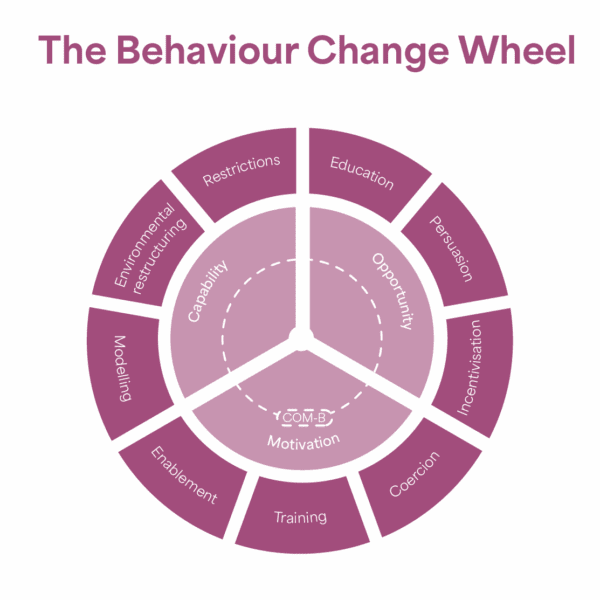
The Behaviour Change Wheel includes nine main ways to help people change what they do. These are called intervention strategies. Each one tackles behaviour from a different angle. Some focus on learning, others on systems or motivation. These nine strategies sit around the Behaviour Change Wheel. Each one targets a different layer of behaviour, from skills and training to motivation and structure.
What makes the Behaviour Change Wheel special is that it shows there is no single way to create change. Good leaders choose the right mix of strategies for their team. They do not rely only on words or motivation. They use design. They build systems that make new habits easy, rewarding, and natural.
1. Education
Education is the first step in the Behaviour Change Wheel. It gives people knowledge that turns into action. Google applies this idea through its re: Work platform. The company studied thousands of teams and found that the best managers showed two key traits: clear communication and psychological safety. Google then shared these findings publicly so everyone could learn from them.
According to McKinsey, companies that communicate clearly and educate consistently are eight times more likely to succeed in transformation programs. This proves how education supports behaviour change. When people understand why a behaviour matters, they are more likely to act on it. Education turns knowledge into momentum, and that is at the core of the Behaviour Change Wheel.
2. Persuasion
Persuasion is another part of the Behaviour Change Wheel. It focuses on emotion rather than logic. Airbnb uses storytelling to inspire empathy. Leaders share stories about hosts who made guests feel welcome or travellers who found belonging in a new city. These real stories remind employees that their work builds human connection.
Research shows that emotional tories are remembered about twenty times more than facts alone. For example, Airbnb once shared the story of a host in Japan who kept a handwritten notebook for guests to write about their stay. That small act of care inspired other hosts to create personal touches that made travellers feel at home. Leaders shared stories like this internally to remind employees that their work is about belonging, not bookings.
The Behaviour Change Wheel teaches that when emotion drives understanding, behaviour follows naturally.
3. Incentivisation
Incentivisation is about rewarding the right behaviours. The Behaviour Change Wheel shows that rewards shape what people repeat. Salesforce uses this through its “Ohana Awards,” which recognise employees who live the company’s values of trust, teamwork, and kindness.

Winners are celebrated for how they work, not just for results. This reinforces positive norms. It also sends a message that culture is built through actions. The Behaviour Change Wheel highlights that motivation can be shaped by small, consistent rewards that show people their efforts matter.
4. Coercion
In the Behaviour Change Wheel, coercion is not punishment. It is setting healthy limits that keep culture strong. Netflix balances freedom with accountability through its “Freedom and Responsibility” culture deck. Employees can make decisions without managerial approval, but they are also held responsible for results. For example, teams manage their own travel budgets, but if spending patterns suggest waste, leaders step in. This balance keeps trust high without losing discipline.
When teams avoid feedback or stop sharing information, it becomes clear that trust is at risk. Boundaries like this protect openness. The Behaviour Change Wheel reminds leaders that limits are not negative. They are guardrails that keep the system safe and fair.
5. Training
Training builds capability, which is one of the foundations of the Behaviour Change Wheel. Microsoft used this strategy during its culture transformation under Satya Nadella. Managers around the world joined short empathy and communication workshops. They practised listening, staying calm under pressure, and asking thoughtful questions.
After one year, surveys showed higher engagement and trust. Employees described their managers as more understanding and more human. Research from McKinsey supports this approach, finding that capability-building is one of the strongest predictors of successful change. The Behaviour Change Wheel proves that skills are the bridge between knowledge and behaviour.
6. Restriction
Restriction means removing barriers that stop people from doing their best work. In the Behaviour Change Wheel, restriction is a design choice that helps people focus. Basecamp did this by banning after-hours work messages. The rule is simple: work during work hours and rest after.
This small change reduced stress and improved productivity. Surveys showed that more than 80% of employees felt less anxious. The Behaviour Change Wheel explains why. By removing unhealthy routines, leaders create space for balance and energy. Restriction can feel strict, but it gives people freedom to perform at their best.
7. Environmental Restructuring
Environmental restructuring is one of the most powerful tools in the Behaviour Change Wheel. It means changing the surroundings so that the right behaviour becomes automatic. Shopify applied this idea when it cancelled all recurring meetings for two weeks.
After this change, the company cut about 12,000 meetings from employee calendars, nearly 36 years of meeting time saved. Time in meetings dropped 33% year over year, and employees reported more focus and creativity. Shopify showed that sometimes you do not need more motivation. You just need a better environment. The Behaviour Change Wheel helps leaders see that space and structure can do what motivation alone cannot.
8. Modelling
Modelling is when leaders show the behaviour they want others to follow. It is one of the most human parts of the Behaviour Change Wheel. Satya Nadella, the CEO of Microsoft, used this approach to change the company culture. He replaced competition with curiosity by admitting what he did not know and asking others to teach him.
This simple act of humility spread through the company. Studies show that employees are far more likely to adopt new behaviours when they see leaders doing them first. Modelling turns leadership into a living example. The Behaviour Change Wheel reminds us that behaviour starts at the top.
9. Enablement
Enablement is about removing barriers so people can take action. It is one of the most empowering strategies in the Behaviour Change Wheel. Adobe used it through the “Kickbox” program. Every employee received a small budget, a guidebook, and a clear process to test a new idea, no permission needed.
The result was hundreds of new projects and innovations. Employees felt trusted and motivated. The Behaviour Change Wheel shows that when people are given the tools and freedom to act, creativity and ownership grow on their own.
The Bigger Lesson
Each of these nine intervention strategies proves a simple truth. People do not change because they are told to. They change when the system helps them learn, try, and succeed.
The Behaviour Change Wheel gives leaders nine clear ways to make that happen. They can educate, persuade, reward, train, and model. They can remove barriers, reshape environments, and create systems where the right behaviour feels natural.
When leaders stop demanding change and start designing it, results last longer. Culture stops being something written on a wall. It becomes something people live every day, and that is the real power of the Behaviour Change Wheel.
How to Use the Behaviour Change Wheel in Your Organisation

Knowing what the Behaviour Change Wheel is and using it are two very different things. Many leaders understand behaviour change in theory, but few know how to apply it in daily work. The good news is that this model is easy to start with. It can fit any team, company, or culture.
Here is a simple step-by-step way to use the Behaviour Change Wheel to create real and lasting change.
Step 1: Identify the Behaviour You Want to Change
Start by naming the exact behaviour you want to improve. Avoid vague goals like “increase motivation” or “build better teamwork.” Choose one clear and visible action. For example, “managers giving real-time feedback” or “employees starting meetings on time.”
When you define the behaviour clearly, it becomes easier to measure, track, and improve. The Behaviour Change Wheel works best when goals are specific and realistic.
Step 2: Analyse It with the COM-B Model
The Behaviour Change Wheel is built around the COM-B model, which stands for Capability, Opportunity, and Motivation. Ask these three questions:
Capability – Do people have the skills and knowledge to do it?
Opportunity – Does the environment make it possible?
Motivation – Do they actually want to do it?
This step helps you find what is missing. If people want to change but lack skills, focus on training. If they have skills but no time, fix the environment. The Behaviour Change Wheel helps you target the real problem instead of wasting time guessing.
Step 3: Choose the Right Intervention
After you find the main barrier, pick one or two strategies from the Behaviour Change Wheel. Each intervention type serves a different purpose. For example:
Training builds new skills and confidence.
Environmental restructuring changes settings so good behaviour becomes easier.
Incentivisation rewards effort and progress.
Keep it simple. Choose strategies that match your team’s needs. When you focus on a few key actions, people can adapt faster.
Step 4: Redesign the Environment
Behaviour always happens inside a system. The Behaviour Change Wheel reminds leaders that systems can either support or block progress. Look around and ask what in your workplace might make the desired behaviour harder.
Maybe meetings take too long, or communication tools are confusing. Even small design changes can make a big difference. For example, if you want more creative ideas, set one “innovation hour” per week with no meetings or emails. Give people time and space to do what you are asking for.
Step 5: Test and Measure
The Behaviour Change Wheel treats change like an experiment. Start small, test what works, and track your progress. Use simple measures such as:
How many feedback conversations happen each week
How many missed deadlines decrease over time
How many employees adopt a new practice
Then review and adjust based on what you learn. Change is not a one-time project. It is a process of testing, learning, and improving.
Step 6: Celebrate and Reinforce
Success grows when people see progress. When new behaviour appears, celebrate it. Share quick wins in meetings or team channels. Public recognition reinforces the new habit and inspires others to join.
Google does this well. It celebrates managers who complete feedback cycles or run reflection sessions. This kind of recognition turns effort into culture. The Behaviour Change Wheel shows that reinforcement is just as important as design.
Conclusion: Design for Change, Don’t Demand It
Real change does not come from speeches or slogans. It comes from design. The Behaviour Change Wheel reminds us that people do not need to be pushed; they need systems that make the right behaviour easy, possible, and rewarding.
Great leaders understand this. They build workplaces where action speaks louder than words and where culture grows through what people do every day.
Because lasting change is not about telling people what to do. It is about designing a world where doing it feels natural.