Farah is a medical student with a love for writing. Her blog writing experience covers a wide range of topics, including business, productivity, sustainability, and science, lending her a diverse perspective. Her experience in SEO ensures that her content is not only engaging but also reaches a wide audience. Connect with Farah on LinkedIn.
Everyone Is Talking About AI Coaching. Very Few Are Using It Well
Everyone is talking about AI coaching right now. LinkedIn posts. HR panels. Leadership webinars. It sounds like the next big answer to every development problem at work. And in many ways, it is powerful. But here’s the truth: very few companies are using it well.
Over the past few years, the number of organisations using AI in at least one business function has more than doubled, according to research from McKinsey & Company. At the same time, coaching has expanded beyond the executive suite. What used to be reserved for senior leaders is now being offered across teams. On paper, this looks like real progress. AI coaching promises access, scale, and constant support. No waiting lists. No heavy budgets. No, “you have to be VP level to qualify.”
But access alone does not guarantee impact.
Coaching used to be exclusive. It was expensive and often limited to top executives. If you were a middle manager trying to handle a difficult team member or prepare for a high-stakes presentation, you likely had no structured support. You learned by trial and error. AI coaching has changed that dynamic. Now, a manager can review the tone of an email before sending it. A team lead can role-play a performance conversation. A director can reflect on weekly leadership habits in minutes.
In my view, the biggest mistake is framing this as a choice between AI coaching and human coaching. As if one has to win. As if one is modern and the other is outdated. That comparison misses the real opportunity.
AI coaching is strong at scale. It works well for daily nudges, habit building, and small course corrections. It can notice patterns in communication or feedback frequency. It can prompt reflection after meetings. It can make development part of everyday work instead of a once-a-quarter event. Human coaching, however, goes deeper. It challenges beliefs. It explores fears. It pushes leaders to confront parts of themselves that an algorithm cannot fully understand.
The real question is not which one is better. The real question is how great leaders are blending both.
That is where the advantage is. And that is where most organisations are still falling short.
Why Traditional Coaching Couldn’t Scale (And Why AI Coaching Changed That)
Traditional coaching
Coaching Was Built for the Few, Not the Many
For years, coaching was treated like a luxury. It was powerful, yes. But it was also rare. Research shows that executive coaching was typically offered to only the top 5% to 10% of leaders in an organisation. That meant most managers never had access to structured development support.
If you were a middle manager leading ten people, handling team tension, and trying to deliver results, you were often on your own. You might attend a workshop once a year. You might read a leadership book. But consistent feedback? Ongoing support? That was usually reserved for senior executives.
The cost made it worse. One-on-one coaching can cost thousands of dollars per leader each year. HR budgets simply could not scale that model across hundreds or thousands of managers. Even companies that believed in coaching could not afford to offer it to everyone who needed it.
The Real Gap: Unsupported Middle Managers
This is where things broke down. Middle managers sit in the hardest spot in an organisation. They translate strategy into action. They manage conflict. They give performance feedback. They shape culture on the ground. Yet they often receive the least structured coaching.
And here is what matters: according to Gallup, managers account for at least 70% of the variance in team engagement. That means the quality of a manager directly affects how motivated and productive a team is.
Now think about that. The people who drive most engagement often do not receive regular coaching. That is not a small gap. That is a system-level problem.
How AI Coaching Changed the Model
This is where AI coaching enters practically.
AI coaching does not wait for a calendar invite. It is available 24/7. A manager can reflect right after a meeting. A team lead can practice a tough conversation before it happens. A new director can review their weekly leadership habits on demand.
It works through simple but consistent actions:
Weekly reflection prompts that ask focused leadership questions.
After-meeting feedback simulations that analyse clarity, participation, or tone.
Leadership scenario practice that lets managers role-play difficult conversations before doing them in real life.
Pattern recognition across many interactions, showing trends over time.
Instead of one big insight every few months, leaders receive small nudges every week. That steady pressure creates real behaviour change.
Do Your Learners Return from Trainingand Do Nothing Differently?
Our Sticky Learning ® method is 7x more effective than 1-day training courses. Plus, we deliver a Chain of Evidence report proving your Return on Investment.
Discover Soft Skills Training that changes behaviours long-term.
Traditional coaching struggled because it depended on time, budget, and human availability. AI coaching scales because it is built into everyday systems. It removes the delay in feedback.
And when feedback is faster, growth is faster.
The real power of AI coaching is not that it replaces human coaches. It is that it fills the gap between human sessions. It supports the managers who would never have had access to coaching in the first place.
For the first time, development does not have to be limited to the top floor. It can happen across the whole organisation.
The Big Myth: “AI Coaching Will Replace Human Coaches”
AI Can Build Discipline. One of the loudest fears right now is that AI coaching will eventually replace human coaches. I do not see it that way. I see it as a category mistake.
AI coaching is strong at training consistency. It reinforces habits. It tracks patterns. It nudges leaders to follow through. If you need to improve how often you give feedback, how you structure meetings, or how clearly you communicate expectations, AI can help. It reminds. It measures. It optimizes.
In that sense, AI optimises behaviour.
And that is valuable. Most leadership problems are not about knowledge. They are about repeated habits.
Humans Build Courage
But here is where it changes. Human coaches do not just improve habits. They challenge identity. They ask why. They notice hesitation in your voice. They hold space when you are uncomfortable. They push when you avoid what really needs to be said.
AI can tell you that you speak too much in meetings. A human coach can ask what you are afraid will happen if you stop. That is a different layer of work. AI can reinforce structure. Humans build courage.
What Great Leaders Are Actually Doing With AI Coaching
Hybrid Coaching
Talking about AI coaching is easy. Using it in a smart, grounded way is harder. The companies getting this right are not treating it as a trend. They are building it into daily leadership habits.
Here is what that looks like in practice.
Microsoft: Turning Daily Work Into a Coaching Loop
At Microsoft, AI tools such as Copilot are integrated into everyday workflows. Leaders can review meeting summaries, check for clarity in communication, and see participation patterns almost instantly. Instead of guessing whether a meeting was effective, managers can look at data on who spoke, what decisions were made, and whether next steps were clear.
That is not abstract. It changes behaviour.
Imagine finishing a strategy meeting and seeing that only two out of eight people spoke. A strong leader does not ignore that. They adjust the next meeting. They invite quieter voices. They design a better structure.
Microsoft’s CEO, Satya Nadella, has often emphasised a growth mindset culture. AI coaching supports that mindset by making reflection part of the workflow, not a separate event.
What readers can apply:
After major meetings, use AI coaching apps to review summaries and participation trends. Do not just move to the next task. Build a five-minute reflection loop.
BetterUp: Blending AI With Human Coaching
BetterUp works with large organisations such as Google and Salesforce to combine AI-driven development tools with human coaching.
Their model is clear. AI coaching tracks goals, nudges behaviour, and gathers data between sessions. Human coaches use that data to go deeper. Instead of asking, “How have things been?” they can review trends and focus immediately on what matters.
That shifts coaching from general conversation to targeted development.
The fact that companies continue investing in hybrid models like this tells us something important. According to recent workplace research, leadership development remains one of the top priorities for HR leaders worldwide. But scale is the challenge. AI coaching fills the gap between sessions, especially for managers who would never receive traditional executive coaching.
What readers can apply:
If you already use human coaching, add AI-based check-ins between sessions. Use the data from AI coaching to guide deeper human conversations instead of starting from scratch each time.
IBM: Personalising Development at Scale
IBM has long invested in AI-driven internal systems, including career and skills platforms powered by its Watson technology. Employees receive recommendations for learning paths, skill gaps, and next career steps based on their data and role.
That does more than suggest courses. It shifts leadership development from guesswork to evidence-based growth.
Instead of waiting for a performance review to discover that a manager lacks strategic thinking skills, AI systems can flag patterns early. Leaders can then focus their development efforts where they matter most.
This is AI coaching at a structural level. It does not replace conversations. It informs them.
What readers can apply:
Use AI skill assessments or analytics to map leadership gaps across yourorganisationn. Do not rely only on annual reviews. Let data highlight where coaching resources should go.
The Pattern Behind the Examples
Across these companies, the pattern is simple. AI coaching is used for daily reinforcement, fast feedback, and pattern tracking. Human coaching is used for emotional depth, strategic shifts, and personal breakthroughs.
The leaders who win are not choosing one over the other. They are designing systems where AI supports everyday habits, and humans support transformation.
That is practical. That is scalable. And more importantly, that is realistic for modern workplaces.
The 3-Layer AI + Human Coaching Stack
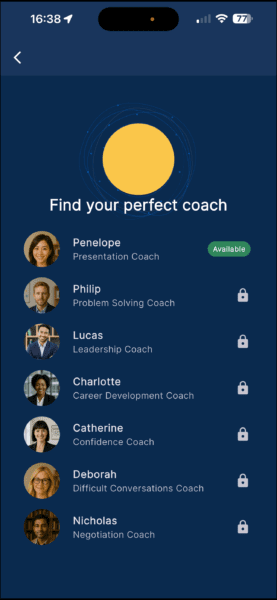
AI coaching app
A Practical Guide Leaders Can Actually Use
If you remember only one part of this article, let it be this: do not treat AI coaching and human coaching as separate programs. Build them into one simple system.
Here is a structure leaders can implement without a massive budget.
Layer 1: The AI Habit Layer
Make leadership growth a weekly habit, not a yearly event.
This layer runs in the background of daily work. Its goal is simple: build consistency.
What it looks like in practice:
1- Weekly Reflection Prompt (10 minutes max)
Every Friday, managers answer 3 AI-generated questions:
Where did I avoid a difficult conversation this week?
Who spoke least in my meetings?
What feedback did I delay?
The key is repetition. The same themes resurface over time. That is how patterns appear.
2- Post-Meeting Review (5 minutes)
After major meetings, leaders upload notes or transcripts into an AI tool. They review:
Participation balance
Clarity of next steps
Emotional tone
Then they set one adjustment for the next meeting.
3- Leadership Simulation Practice (15 minutes per week)
Managers role-play high-stakes conversations using AI coaching tools:
Poor performance discussion
Conflict between two team members
Pushback from a senior stakeholder
The goal is rehearsal. Athletes practice before games. Leaders should,d too.
Why this works:
Small, repeated nudges changbehaviouror faster than one big training session.
How mid-sized companies can afford this:
You do not need a custom platform. Many AI tools already exist. Start with:
One team.
One weekly reflection cycle.
One required post-meeting review for all department heads.
Keep it simple. Consistency matters more than complexity.
Layer 2: Quarterly Human Strategy Sessions
Use human coaching where it creates leverage.
This layer happens every 90 days.
Instead of generic coaching conversations, use data collected from Layer 1. That changes the depth of the discussion.
Structure a 60-minute session like this:
1- Pattern Review (15 minutes)
Look at AI coaching data:
Recurring behaviour gaps
Feedback frequency
Meeting balance trends
2- Blind Spot Exploration (25 minutes)
The coach asks:
What belief might be driving this behaviour?
What is uncomfortable about changing it?
Where does ego show up?
3- Strategic Shift (20 minutes)
Set one deliberate leadership shift for the next quarter.
Not five. One.
This is where human coaching shines. It moves from surface behaviours to identity-level growth.
How to implement without a big budget:
You do not need a full-time executive coach for everyone.
Options:
Group coaching for mid-level managers.
Bring in a coach quarterly, not monthly.
Train senior leaders internally to facilitate structured sessions.
The key is focus and depth, not frequency.
Layer 3: Critical Moment Intervention
Reserve intensive human support for high-stakes moments.
This layer activates when the stakes are high.
Examples:
Promotion to senior leadership
Majoorganisationalal change
Crisis communication
Merger or restructuring
Public failure or reputational risk
These are identity-stretching moments. They require nuance and emotional intelligence.
In these situations, AI coaching can support rehearsal and communication clarity. But human coaching should lead the space.
A simple protocol leaders can adopt:
1- Define the moment clearly.
What is the risk if this goes wrong?
2- Combine rehearsal and reflection.
Use AI to simulate the key conversations.
Use a human coach to unpack fear, pressure, and decision values.
3- Debrief within 48 hours after the event.
Capture lessons immediately.
Budget reality for mid-sized firms:
You do not need standing contracts for every leader. Set aside a small “critical moment” coaching fund. Use it only when the stakes justify it.
Think of it like legal counsel. You do not use it daily, but when you need it, you really need it.
Example Scenario
Let me make this simpler.
Imagine a marketing director in a 250-person company. She just got promoted. Now she’s leading people who used to be her peers. Meetings feel tense. One senior team member keeps pushing back. She starts leaving meetings frustrated, but she is not sure what exactly is going wrong.
Here is how the three layers work in real life.
At the AI habit layer, she runs her last two meeting summaries through an AI coaching tool. She sees that she is speaking most of the time and interrupting more when challenged. That is uncomfortable to read, but it is clear. Before the next meeting, she uses AI to rehearse responding calmly to pushback. Small change. Better tone. More questions.
Then comes the quarterly human session. Her coach looks at the same patterns and asks a tougher question: “What does it mean to you when someone challenges you in front of others?” That hits deeper. She admits she feels she has to prove she deserves the promotion. Now they are not just fixing interruptions. They are addressing insecurity.
A month later, a big client complains publicly about delays. High pressure. She activates the critical moment layer. She practices her client message using AI for clarity and structure. Then she talks it through with her coach to manage nerves and make sure she leads with calm confidence, not defensiveness.
The issue has been resolved. That is the stack in action. AI coaching supports the weekly habits. Human coaching tackles the deeper beliefs. And during high-stakes moments, both work together.
A Quick Word on Ethical AI Coaching: The ICF Standards
As AI coaching becomes more widespread, ethical guardrails matter just as much as practical use. The International Coaching Federation (ICF), the world’s largest coaching body, has released an AI Coaching Framework and Standards that guide organisations and coaching providers in integrating AI tools responsibly.
These standards are designed to ensure AI coaching supports human development without compromising trust, ethics, or client safety. They cover key areas such as:
Ethics and foundational principles: ensuring AI systems are built on transparency, fairness, and integrity.
Co-creating the coaching relationship: AI should support, not replace, human connection and trust.
Effective communication and growth facilitation: AI outputs should align with proven coaching practices and promote real insight.
Technical safeguards: including privacy, data protection, and accessibility standards.
The Risks Nobody Talks About
AI coaching is powerful. But if we are being honest, it also comes with risks that few leaders say out loud.
1- When Empathy Becomes Automated
AI can suggest softer phrasing. It can flag harsh tone. It can recommend inclusive language. That is useful. But there is a fine line between support and substitution.
If leaders depend on AI to “sound empathetic” without actually doing the emotional work, empathy turns into performance. Teams can sense that. Real trust does not come from perfectly written sentences. It comes from presence, from listening, from sitting in awkward silence when someone is upset.
AI can refine language. It cannot replace emotional courage.
2- Hiding Behind Dashboards
Another risk is safety through data.
It is easier to review analytics than to confront a conflict. Easier to study engagement trends than to address the one employee who is clearly disengaged. AI coaching can show patterns in participation, tone, and feedback frequency. But it cannot walk into the room for you.
I worry when leaders start saying, “The data shows…” instead of “Let’s talk.”
Data should start conversations, not replace them.
3- Replacing Feedback Culture by Accident
There is also a cultural risk.
If AI coaching becomes the main source of feedback, teams may slowly stop giving feedback to each other. People might assume the system will detect performance gaps or communication issues. But healthy cultures depend on peer-to-peer honesty.
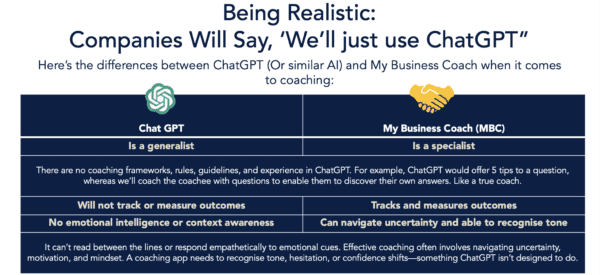
Let’s be honest. Some companies will say, “We’ll just use ChatGPT for coaching.”
AI tools like ChatGPT are powerful. They are fast, accessible, and useful for generating ideas or structuring thinking. But coaching is not just about giving advice. It is about guiding discovery, tracking growth, and working through ambiguity.
A specialist coach operates within proven frameworks. They measure progress over time. They read tone, shifts in hesitation, and shifts in confidence. They challenge assumptions and sit with uncertainty. That level of depth is different from generating helpful responses.
This is not about choosing one over the other.
It is about understanding the difference between a general AI tool and a structured coaching process. AI can support reflection. A trained coach drives transformation.
Conclusion
AI coaching is not the future of leadership. It is already here. The real question is how we use it.
The strongest leaders are not debating whether AI coaching is better than human coaching. They are designing systems where both work together. AI strengthens habits. Human coaches challenge identity. Critical moments receive deeper support.
That combination creates something powerful: leaders who are consistent, self-aware, and prepared.
If you are leading a team today, start small. Add one weekly AI reflection. Schedule one deeper coaching conversation each quarter. Treat high-stakes moments as opportunities for rehearsal, not improvisation.
AI coaching is a tool. It becomes an advantage only when leaders use it with intention.
And the leaders who get this right will not just keep up. They will pull ahead.