
It’s About Leading with Flexibility
Good leaders know how to guide people. Great leaders know when to change how they lead. What motivates one person might not work for another, and that is why situational leadership matters. It helps leaders adjust their approach based on what their team needs in each moment.
Research shows that using a situational leadership style can make a big difference. Teams that follow this approach have been found to show 61% higher job satisfaction and 50% better performance in small and medium-sized companies.
The theory was created by Paul Hersey and Ken Blanchard in the 1970s. They believed that there is no single “best” way to lead. Instead, great leaders are flexible. They look at what each situation and person needs, then change their style to fit.
Think of it like a GPS. You always know your destination, but the route changes depending on the road and the people in the car with you.
In this article, you will learn what situational leadership is, the four styles it includes, and how to use it in real life. You will also see examples from well-known leaders that can help you apply this method in your own team. By the end, you will know how to assess a situation, adapt your leadership style, and lead with clarity, empathy, and confidence.
Jump Menu:
- 1 What is Situational Leadership?
- 2 What Are the 4 Leadership Styles Identified in Situational Leadership Theory?
- 3 What Are the Advantages and Disadvantages of Situational Leadership?
- 4 Key Traits of Situational Leaders
- 5 Implementing Situational Leadership
- 6 Situational Leadership in Practice
- 7 Examples of Situational Leaders
- 8 The Impact of Culture on Situational Leadership
- 9 Alternatives to Situational Leadership
- 10 Looking Beyond the Advantages and Disadvantages of Situational Leadership
1. What is Situational Leadership?
Situational leadership is a leadership theory that focuses on adapting your style to fit the situation and the people you are leading. It challenges the idea that there is one best way to lead. Instead, it says that the most effective leaders know when to guide, when to support, and when to step back.
The core idea is simple: different people need different things from their leaders. A new employee might need clear instructions and close supervision, while an experienced team member might prefer more freedom and trust.
According to Paul Hersey and Ken Blanchard, leadership success depends on two key factors:
-
Competence — how skilled or experienced a person is.
-
Commitment — how motivated or confident they feel.
By looking at these two factors, a leader can decide which style to use. For example:
-
If someone is new and unsure, they may need a clear, directive style.
-
If they are skilled but unmotivated, they may need encouragement and emotional support.
-
If they are highly skilled and confident, the leader can delegate and give them full responsibility.
In short, situational leadership is about reading the room. It helps leaders match their approach to the situation so that every team member gets the right balance of guidance and independence.
2. What Are the 4 Leadership Styles Identified in Situational Leadership Theory?
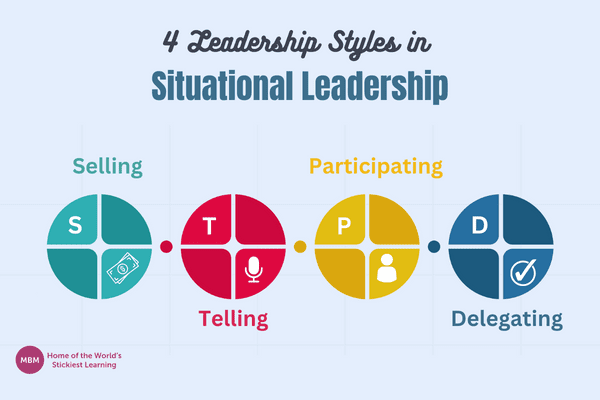
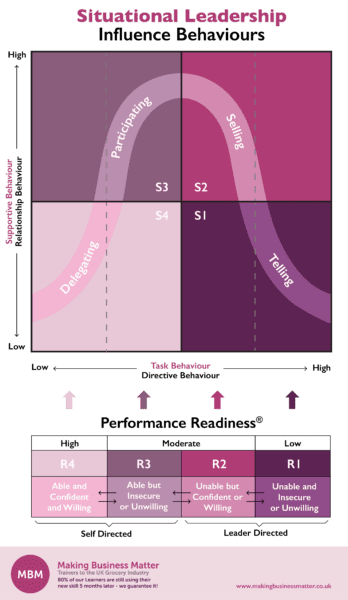
Situational leadership theory identifies four main leadership styles. Each style combines different levels of direction and support, depending on what followers need. The four styles are telling, selling, participating, and delegating, and each works best in a specific type of situation.
1- The Telling Style:
This is the most direct style. The leader gives clear steps, sets goals, and checks the work often.
It is best for people who are new or not sure what to do. For example, Elon Musk used this style in SpaceX’s early days. When the team was still learning how to land rockets, he gave close instructions and guided every step. His hands-on approach helped the team stay focused and succeed in something completely new.
Our Sticky Learning ® method is 7x more effective than 1-day training courses. Plus, we deliver a Chain of Evidence report proving your Return on Investment. Discover Soft Skills Training that changes behaviours long-term.

2- The Selling Style:
This style still gives direction, but also explains and motivates. The leader shows the team why the work matters and helps them believe in the goal. Satya Nadella, the CEO of Microsoft, used this style when he joined in 2014.
He wanted to change the company culture from competition to teamwork. He spoke about the idea of a “growth mindset,” explained his vision clearly, and inspired employees to join in. His mix of guidance and encouragement brought new energy to Microsoft.
3- The Participating Style:
This style is about working together. The leader gives less instruction and more support. They ask for ideas, listen, and share decisions with the team. Howard Schultz, CEO of Starbucks, used this approach when he returned in 2008. The company was struggling, so he asked employees for honest feedback and ideas to fix problems. This teamwork helped Starbucks recover and rebuild trust with its customers.
4- The Delegating Style:
This style works best for skilled and confident teams. The leader steps back and lets people manage their own work. They give support only when needed. Steve Jobs used this style at Pixar. He trusted creative leaders like John Lasseter and Ed Catmull to make big decisions on their own. Jobs focused on vision and resources while the team handled the creative process. This trust helped Pixar create award-winning films and a culture of creativity.
Click the image below for a larger version:
3. What Are the Advantages and Disadvantages of Situational Leadership?
Advantages of Situational Leadership:

#1- Increased Flexibility
One big advantage is flexibility. Leaders can change their style to fit the situation. This helps them guide new employees closely and give experienced ones more freedom. It also builds trust because people see that their leader understands what they need.
#2- Improved Communication
Another advantage is better communication. Situational leaders talk often with their team, listen to ideas, and give clear feedback. This creates open two-way communication where everyone feels heard and understood. A review of the literature found that when leaders tailor their style to individual competence levels, followers report higher engagement and involvement in decisions.
#3- More Efficient Resource Allocation
It also leads to higher motivation. When leaders give the right mix of support and independence, people feel trusted. Research shows that this approach can increase job satisfaction by about 60% and boost performance by around 50%. Motivated people work harder and enjoy their jobs more.
#4- Enhanced Motivation
Situational leadership can enhance motivation by aligning leadership style with the needs and abilities of followers. By matching the level of direction and support to the competence and commitment level of followers, leaders can help to create a more motivating work environment. This can help to improve morale and job satisfaction, leading to increased productivity and better outcomes.
#5- Better Decision-making
Finally, it leads to better decisions. Situational leaders think about people’s skills, confidence, and the task before acting. This careful thinking helps them choose the best approach and make decisions that work well for everyone.
Disadvantages of Situational Leadership

#1- Complexity
One challenge is complexity. It can be hard to judge what each person needs and to change styles often. Leaders can fix this by getting training and practicing the model until it feels natural.This can help to build leaders’ understanding and confidence in their ability to use situational leadership effectively.
#2- Time-Consuming
Another issue is time. It takes effort to assess people and adjust leadership styles regularly. To save time, leaders can focus on key points like skill level and motivation, or delegate small tasks to others.
#3- Potential for Misinterpretation
There is also the risk of confusion. When a leader changes styles, the team might not understand why. This can cause mistrust. The best way to avoid this is by explaining decisions clearly and keeping communication open.
#4- Inconsistency
Lastly, culture can affect how well situational leadership works. Some cultures prefer clear direction, while others like more teamwork. A study shows that while this style often improves job satisfaction, its effect on performance can depend on company culture and employee values.
Now that you’re informed about the advantages and disadvantages of situational leadership, let’s move to some key traits.
4. Key Traits of Situational Leaders

#1. Adaptability as a Cornerstone
Great leaders can change their style when the situation changes. Indra Nooyi, former CEO of PepsiCo, showed this clearly. When PepsiCo started focusing on healthier food and drinks, she used a different approach with each team. With top managers, she worked in a collaborative way, asking for input. With newer employees, she gave clear goals and structure. Her adaptability helped the company grow during a big shift.
#2. Effective Communication Mastery
Situational leaders are clear and calm communicators. Barack Obama is known for this skill. When leading his team or speaking to the public, he explained things in simple terms and listened carefully to others. His clear communication helped people understand complex issues and trust his decisions.
#3. Emotional Intelligence at the Forefront
Good leaders pay attention to how people feel. Jacinda Ardern, former Prime Minister of New Zealand, showed strong emotional intelligence during the COVID-19 crisis. She spoke with empathy, reassured people, and made tough choices when needed. Her ability to balance kindness and firmness made her leadership effective and human.
#4. Proactive Decision-making Prowess
Situational leaders act before problems grow. Tim Cook, CEO of Apple, is known for making fast, careful decisions. Before supply issues hit the company in 2020, he had already planned new supplier options. This early action kept Apple’s products on schedule when other companies struggled.
#5. Commitment to Continuous Learning
Situational leaders keep learning. They ask for feedback, reflect on mistakes, and always try to improve. Mary Barra, CEO of General Motors, encourages this culture. She asks employees to find problems early, learn from them, and share what they discover. By doing this herself, she sets an example for her whole company.
Now, moving from key traits to practical aspects, let’s discuss the advantages and disadvantages of situational leadership to help you make informed decisions in your leadership approach.
5. Implementing Situational Leadership

1- Assessing Situations:
Look at each team member carefully.
Ask two questions:
-
How skilled are they?
-
How confident or motivated are they?
If someone is new, they need clear steps and close support.
If they know the job but are not confident, they need guidance and encouragement.
If they are skilled and confident, they can work more independently.
You can also ask them directly, “Do you want more help or more freedom?”
Short talks like this show you what each person needs most.
2- Adjusting Leadership Styles:
After you know what people need, choose the right style for each person.
| Situation | Best Style | What to Do |
|---|---|---|
| New or unskilled employee | Telling | Give clear steps, set deadlines, and check progress often. |
| Skilled but unsure employee | Selling | Explain why the task matters, motivate them, and guide gently. |
| Skilled but low in motivation | Participating | Involve them in decisions and ask for ideas. |
| Skilled and confident employee | Delegating | Give them full control, step back, and trust their judgment. |
3- Communicate Clearly:
Tell your team why you are using a certain style.
You might say, “I’ll stay close until you feel confident,” or “You’ve done this before, so I trust you to lead it.”
Clear communication helps people understand your choices.
Ask for feedback often. Simple questions like “Is this working for you?” help you learn what your team needs.
4- Training and Development:
Situations always change. A new employee can become skilled quickly. A top performer might lose motivation under stress. Check in often to see if your approach still fits. If not, adjust it.
You can use a simple 3-step reflection after each project:
-
What worked well with my leadership approach?
-
What didn’t?
-
What can I do differently next time?
Small adjustments make a big difference over time.
Let’s look at how actual leaders demonstrate situational leadership in areas like business, the military, and technology.
6. Situational Leadership in Practice

Situational leadership is not just an idea you read about in books. It is something real leaders use every day to guide their teams. Here are a few examples of how it looks in action across different fields.
1. Business
When Howard Schultz returned as CEO of Starbucks in 2008, the company was in trouble. Sales were dropping, and morale was low. Instead of using one strict leadership style, Schultz adapted. At first, he took a clear “telling” approach, closing underperforming stores, training staff again, and setting firm rules to rebuild quality. Once things stabilized, he shifted to a “participating” style. He invited employees, known as partners, to share ideas for improving customer experience. This flexible approach helped Starbucks recover and rebuild its culture of connection and trust.
2. Education
Situational leadership is also widely used in education, where teachers must adapt their approach to meet the needs of their students. For example, a teacher may use a more directive style when teaching a new concept, but shift to a more supportive style once the students have mastered the material. By adjusting their style to the needs of the students, teachers can improve engagement and learning outcomes.
Many Finnish schools use situational leadership at the principal level. Principals adapt their style depending on the experience of teachers. With new teachers, they are more directive, setting clear expectations and providing mentoring. With experienced educators, they give autonomy and involve them in decisions about school programs.
3. Healthcare
In hospitals, experienced nurses and doctors often lead teams with different levels of skill. A senior nurse might give clear orders to a new staff member during an emergency (telling), but later allow a trained colleague to take the lead in a routine procedure (delegating). By adjusting their approach, healthcare leaders make sure care stays safe while also helping new staff build confidence. In a study on nursing management, researchers showed that using the Situational Leadership Theory helped nurse-managers adjust their style to different nurses’ skill and motivation levels.
4. Sports
Sports coaches are excellent examples of situational leaders. A coach might give detailed instructions to new players who are still learning, but with experienced athletes, they focus more on motivation and teamwork. John Wooden, the legendary UCLA basketball coach, changed his leadership style depending on each player’s needs. He knew when to teach, when to encourage, and when to trust. That balance helped him build one of the most successful teams in history.
5. Creative Industries
Creative industries often need flexible leadership. For example, Steve Jobs showed situational leadership at Pixar. While he was known for being demanding at Apple, at Pixar he trusted creative experts to make their own choices. He focused on vision and resources while giving artists and directors freedom to experiment. That trust helped Pixar produce a series of award-winning films and maintain a strong culture of creativity.
7. Examples of Situational Leaders

#1- Colin Powell
Colin Powell, the former U.S. Secretary of State and Army General, was known for adapting his style. With young soldiers, he gave clear, step-by-step instructions. With experienced officers, he trusted them to decide on their own. In an interview with Forbes, Powell articulated his approach, stating, ‘I adjust my style, within limits, to the strengths and weaknesses of my subordinates so that I understand what they can and can’t do.’
#2- Steve Jobs
Steve Jobs, the co-founder of Apple, also used different leadership styles. When Apple was new, he was very strict and gave close direction to build high standards. Later, when he helped run Pixar, he changed. He trusted the creative team to lead their projects and only gave advice when needed. This flexibility helped both companies grow and succeed.
#3- John Wooden
John Wooden, the famous basketball coach at UCLA, led his players in different ways. When players were new, he gave clear instructions and daily practice routines. When they became more experienced, he encouraged them and let them lead more on the court. His way of adjusting to each player helped him win many championships.
#4-Jacinda Ardern
Jacinda Ardern, the former Prime Minister of New Zealand, also showed situational leadership. During the COVID-19 pandemic, she used a direct style, giving clear rules to keep people safe. Later, she listened more to experts and local leaders when planning the next steps. Her calm, kind, and flexible approach helped people trust her leadership.
8. The Impact of Culture on Situational Leadership

Culture affects how people see leaders and how they react to them. What works well in one country or company may not work the same way in another.
In some cultures, people expect their leader to give clear orders and make all the big decisions. In other cultures, people prefer leaders who ask for opinions and make decisions together with the team. A good situational leader understands these differences and adjusts their style to fit.
For example, in Japan or South Korea, leaders are often more formal and directive. Teams expect structure and clear instructions. In countries like Sweden or the Netherlands, leaders are more open and collaborative. They encourage everyone to share ideas.
When working with a mixed team from different backgrounds, communication becomes even more important. Leaders should ask questions, listen carefully, and check that everyone understands. Simple actions like repeating key points or inviting quiet team members to speak can make people feel included.
Building trust also takes time across cultures. Some people may need more personal connection before they feel comfortable sharing ideas. Others may trust quickly if the leader shows fairness and respect.
Finally, leaders who value diversity make stronger teams. They learn from different viewpoints and use those differences to find better solutions. Situational leadership works best when leaders see culture not as a barrier, but as a strength.
9. Alternatives to Situational Leadership – Let’s Step Away a Bit from the Advantages and Disadvantages of Situational Leadership
While situational leadership is a popular and effective leadership theory, it is not the only approach to leadership. In fact, there are several other leadership theories and approaches that can complement or serve as alternatives to situational leadership. In this section, we will explore some of these alternatives to supplement what we already discussed about the advantages and disadvantages of situational leadership.
1. Transformational Leadership:
Transformational leaders inspire people to do more than they thought possible. They lead through vision and motivation. These leaders talk about the bigger picture and help their teams believe in a shared goal.
For example, Nelson Mandela used this kind of leadership. He inspired others with hope and a clear vision of equality. Transformational leadership works best when a team needs energy, purpose, and inspiration to move forward.
2. Servant Leadership:
Servant leaders put their people first. They focus on helping others grow and succeed before thinking about their own needs. This kind of leader listens, supports, and gives credit to the team.
Mother Teresa is an example of a servant leader. She worked to serve others with kindness and humility, inspiring people by example. In the workplace, servant leadership creates loyalty and trust because people feel valued.
3. Authentic Leadership:
Authentic leaders are honest and consistent. They act according to their values and speak openly with their teams. They lead by being genuine, not by pretending to be perfect.
Oprah Winfrey is a well-known authentic leader. She often speaks about her struggles and uses her experiences to help others grow. Her openness and honesty make people trust her message and follow her lead.
10. Looking Beyond the Advantages and Disadvantages of Situational Leadership

Situational leadership has been popular for many years. It has helped many leaders adjust their approach to fit different people and situations. But as workplaces and cultures keep changing, leaders must think about how this style can evolve and stay useful.
#1. Technological Advancements
Technology has changed how people work and talk to each other. Many teams now work online or from different countries. This means leaders must learn new ways to guide and support people they do not see in person.
Situational leadership can still help. For example, a leader can give clear steps to a new remote worker, then offer more freedom once that person feels confident. Regular video calls and simple check-ins help everyone stay connected and on track.
#2. Multigenerational Workforce
Today’s workplaces include people from many age groups, from Baby Boomers to Gen Z. Each group has its own way of working and communicating. Younger workers may like more freedom and quick feedback. Older workers may prefer structure and experience. Situational leadership works well here because it allows leaders to adjust. They can give clear direction to newer staff and more independence to skilled, experienced workers.
#3. Remote Work
More teams now include people from many cultures and countries. Leaders need to understand these differences and communicate with care. Situational leadership helps by reminding leaders to listen first, stay open, and adjust their approach. When leaders show respect and flexibility, they build trust and create stronger, more united teams.
How to Start Using Situational Leadership
If you want to start applying situational leadership, begin with one small step. Choose one team member and think about what they need most right now, more guidance or more freedom. Try adjusting your leadership style just for that person for one week. Watch how they respond and make small changes along the way. You’ll quickly see what works best and start building confidence in using the model naturally.
An easy way to remember how situational leadership works is with the “4Ds”: Direct, Discuss, Develop, and Delegate.
-
Direct when someone is new and needs clear steps.
-
Discuss when they are learning and need encouragement.
-
Develop when they are improving and ready for shared decision-making.
-
Delegate when they are skilled and confident enough to lead on their own.
These four words can guide you through almost any leadership situation. Start simple, pay attention to your team’s needs, and let your flexibility grow over time.
Finally, Our Conclusion on the Advantages and Disadvantages of Situational Leadership
Situational leadership is useful because it helps leaders stay flexible. It can work in many types of teams and situations. When leaders look at what each person needs and change their style to match, communication improves. People feel more motivated, and decisions become easier and clearer.
Still, this approach has some challenges. It can be hard to use because it takes time and careful thinking. Sometimes, people may also misunderstand the leader’s changes in style. To avoid problems, leaders should explain their choices clearly and make sure everyone understands why they are doing things a certain way.
Updated: October 2025 by Farah Yasser Salama