
Top 15 Coaching Question Stems to Create Powerful Coaching Questions
Because “How’s it going?”, or “What’ve you been up to?” are not a coaching questions.
Why These Coaching Questions Work:
Coaching isn’t therapy. It’s not mentoring (Mentoring tells, Coaching asks. Simple). It’s not consulting. It’s a conversation with purpose, and coaching questions are your power tools. But not just any questions. These 15 coaching questions that are designed to unlock insight, shift perspective, and spark action. They’re the difference between “meh” and “wow”.
Let’s dive in to these coaching questions and find out more…

Our 15 Coaching Questions:
- “What does success look like for you?”
This isn’t about KPIs or what their boss wants. It’s about their vision. It helps them define what winning means; personally, professionally, emotionally.
Clarity is power in these coaching questions.
When most people think of goals, they usually consider what they would like to own. A big house. A Ferrari. But remember, goals are either:
To Have – a Ferrari, a Big house, or Time with your family.
To Be – CEO, Mum, or Number #1.
To Do – Give a TED talk, swim with dolphins, run a marathon.
Remember…the overriding goal should be to be happy, first and foremost.
- “What’s holding you back?”
This one invites honesty. It surfaces fears, doubts, and external blockers. Sometimes it’s a lack of time. Sometimes it’s a fear of judgment. Either way, you’ve got something to work with.
Coaches…don’t judge.
- “If you could do anything without fear of failure, what would it be?”
Fear is the invisible fence. This question removes it, temporarily, so they can dream big. Often, what they say here is what they really want but haven’t dared to admit.
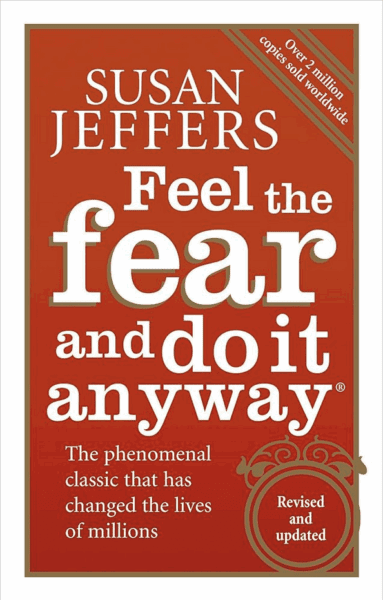
Book recommendation: Feel the fear and do it anyway by Susan Jeffers
- “What’s the smallest step you could take right now?”
Big goals are great. But they can paralyse. This question shrinks the mountain into a molehill. It builds momentum and makes action feel doable.
Alan Lakein, the grandfather of time management, suggested that when it comes to big tasks, like big goals and big steps, think Swiss Cheese. How can you make a hole in the cheese? Practical, simple, and easy should be the first step because once you have taken the first step, the snowball will start rolling down the hill.
- “What would your future self say about this?”
Perspective is everything. This question zooms out and invites wisdom. It helps them see past the panic of now and into the clarity of later.
Different coaching questions can be asked here. Ask the coachee to consider themselves 12 months from now, 3 years, 5 years, and 10 years. One year on is the easiest to envisage, and 10 years the hardest. Sometimes you might want to challenge softly, and other times, a tougher challenge is needed.
- “What’s most important to you right now?”
This is one of the most open of these coaching questions.
Priorities shift. This question helps them reconnect with what truly matters at this moment. It’s a compass reset.
- “What have you tried so far, and what worked best?”
This one encourages reflection and learning. It stops the cycle of doing the same thing and expecting different results. It also builds confidence by highlighting what has worked.
Recently, a coachee was sharing their struggles with confidence and how they had tried many counselling sessions, all of which failed. As coaches, we need to take a moment before we leap after hearing this scenario. The temptation is to want to help and to do your best by stepping into the problem with the coachee.
Beware, as a coachee can be looking for another badge to wear – ‘Yes, 15 therapy sessions and 6 coaching sessions with this great coach, and no one can help’.
The coaching questions we need to ask ourselves, and then the coachee, are about how motivated they are to change, as most people don’t want to because change is hard. By exploring their motivation, you are asking them to discover whether they truly want to change, with a healthy reservation that they won’t.
- “What would you do if you weren’t worried about what others think?”
People-pleasing is a dream killer. This question invites authenticity. It helps them strip away the noise and tune into their own voice.
Kahler’s five drivers is a great questionnaire for the coachee to complete to discover their driver as people pleasing is, like all other drivers, a great strength and a great weakness. It’s not about changing who you are. It is…
‘Know thyself’, Socrates.

- “What’s the cost of not changing?”
Change is hard. But staying stuck has a price. This question makes that price visible; missed opportunities, stress, stagnation.
It creates urgency.
Many people make no decision without accepting that no decision is a decision. A decision to stay the same or accept what is. This question explores that wonderfully.
- “What do you want to have achieved by the end of this session?”
This sets the intention. It gives the session direction and helps both coach and coachee stay focused. It also provides a way to measure progress.
This is a standard question for me in every coaching session.
- “Score that out of 10…”
Simple, but powerful. Whether it’s confidence, clarity, or commitment — scoring helps quantify the intangible. It also opens the door to follow-ups like “What would make it a 9?”
Combined with the GROW model, it can really help to explore the goal: ‘I want to be 8 out of 10’, and the Reality: ‘I am currently a 4’.
- “What would your best friend say about this?”
This adds empathy and external perspective. It often reveals how harshly someone is judging themselves and what a kinder, more balanced view might look like.
- “What would you think about this in 5 years?”
Time-travel coaching. This question reduces emotional intensity and helps them see the long game. It’s a great way to challenge short-term thinking.
- “If nothing changes, what will happen?”
This is the reality check. It forces them to confront the consequences of inaction. Typically, it’s the nudge they need to move from stuck to stirred.
- “What belief might be holding you back?”
Limiting beliefs are sneaky. This question helps surface them — “I’m not good enough”, “I’m too old”, “I don’t have time”. Once named, they can be reframed. Coaching questions around obstacles and consequences are really useful for evoking reflection.
Coaching Questions – Final Thought:
Ask Less. Listen More.
These coaching questions are powerful, but only if you listen to the answers.
Coaching isn’t about ticking boxes. It’s about creating space for insight.
So ask with curiosity. Listen with presence. And trust that the right question, asked at the right time, can change everything.