
Stop Taking Meeting Notes. Start Capturing the Deal.
Most people think meeting notes are there to record what happened. That makes sense in a normal meeting. You write down the key points, the actions, the deadlines, and who agreed to do what. Then someone emails the meeting notes around afterwards, and everyone moves on.
But negotiations are different.
In a negotiation, the deal is rapidly changing while the meeting is unfolding in front of you. A price moves. A deadline shifts. Someone adds a variable. Someone offers a small extra. Someone agrees to something, but only if something else changes too.
This is where normal meeting notes start to fall apart.
They may record parts of the conversation, but they often miss the movement of the deal. And that movement is where great negotiators make a difference because it helps both parties to stay on track and keep moving forward.
I think this is one of the most overlooked parts of negotiation. We teach people how to prepare, how to ask better questions, how to listen, and how to build their confidence. But we don’t teach them how to track the deal as it changes in real time.
That is a problem.
Because if your meeting notes do not show what changed, what was offered, and what was traded, those notes are not helping you negotiate. They are just giving you a rough memory of the conversation.
The Big Mistake: People Write Fragments, Not Deals

This is where most negotiation meeting notes go wrong.
People do not usually write bad meeting notes because they are lazy. They write bad meeting notes because they are trying to negotiate, which is often a tough conversation anyway, whilst also trying to take chnaging notes. Doing both badly. Plus, they don’t know how to take notes better. So they grab the easiest details and hope they will make sense of them later.
A Deal Is More Than A Number
In many negotiations, people focus too much on price, and that is where a negotiation is different to a haggle.
It makes sense because price is easy to write down. It is clear. It feels important. It usually gets the most attention in the room.
But price is rarely the whole deal.
Before the meeting, this is why preparation matters. Harvard Law School’s Program on Negotiation advises negotiators to prepare by thinking about their goals, BATNA, deadlines, interests, and reservation points before entering a negotiation.
In our world, this is the kind of thinking we ask people to do before the meeting using the Squaredance template. It is a one-page negotiation template that helps you think through four key areas before you walk into the negotiation.
A deal can include many negotiation variables, like:
- Payment terms
- Delivery dates
- Warranty
- Service levels
- Contract length
- Extras
- Support
- Risk
- Timing
- Conditions
This is why negotiation meeting notes need to show more than the headline number.
For example, £5,000 with no warranty and collection next week is not the same as £5,200 with a three-month warranty and collection tomorrow.
The second deal may cost more, but it may also give more value.
If your meeting notes only say “£5,000” and “£5,200,” you miss the trade.
The Simple Rule
If a note cannot answer, “What is the complete summary so far?” then it is not enough.
PEPSI is a simple way to remember the 5 stages of a negotiation:
A good negotiation note should at least show:
- What has been agreed
- What we offered
- What they offered
- What has changed (By comparing one deal to a previous deal using your notes)
This is how meeting notes become useful during the negotiation, not just after it. They stop being a rough memory of the conversation. They become a live picture of the deal.
Our Sticky Learning ® method is 7x more effective than 1-day training courses. Plus, we deliver a Chain of Evidence report proving your Return on Investment. Discover Soft Skills Training that changes behaviours long-term.

The Second-Hand Car Example: From Scribbles to Deal Capture
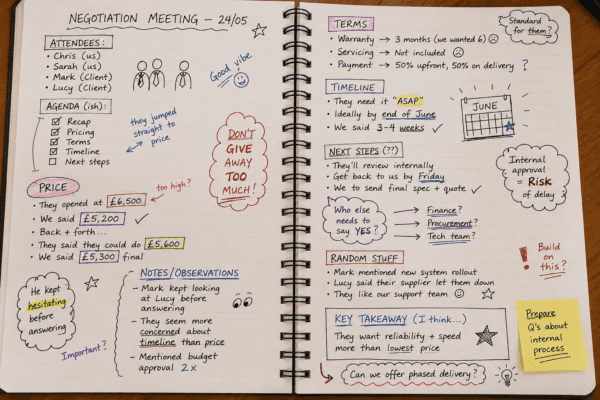
The image shows typical notes. They’re not helpful. Let’s make this practical…
Imagine you are buying a second-hand car. The seller wants one price. You want another. There is also a part exchange, a possible warranty, servicing, and the question of when the car can be collected. Plus, many other possible variables.
This is exactly the kind of negotiation where meeting notes can either help you or confuse you. Like the notes taken in the image above.
The first step is not to create a perfect legal record. That is too much for most people during a live negotiation.
The first step is simpler.
Write the deal in a way that helps you see what is agreed upon and what is still being discussed.
Version 1: The Typical Scribble
Most people start with something like this:
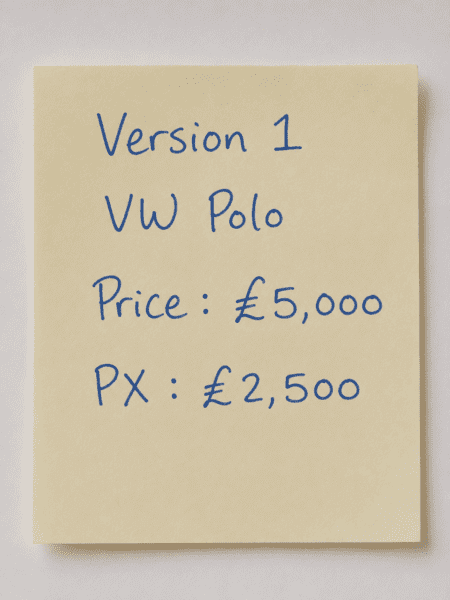
At first, this looks useful. You have written down the car, the price, and the part exchange value.
But later, it may not tell you enough.
- Was £5,000 their offer or your offer?
- Was the part exchange agreed?
- Was there a warranty?
- Was servicing included?
- Was the collection discussed?
This is not a bad note. It is just a weak one.
It gives you a memory prompt, but it does not show the deal.
Version 2: Separate Them and Us
A better version is to show both positions.
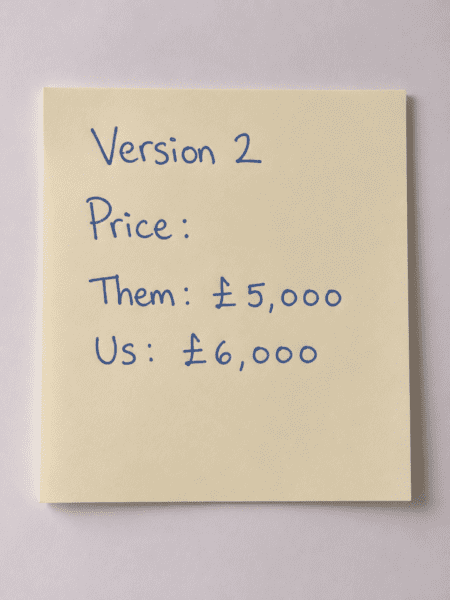
This is already much clearer.
Now you can see the gap. You know what they want. You know what you want.
This is important because in a negotiation, a number on its own is rarely enough.
If your meeting notes only say “£4,500,” you may forget what that number means. Was it agreed? Was it your opening offer? Was it their counteroffer? Was it linked to another condition?
A simple “Them / Us” note solves that problem.
Version 3: Capture the Full Deal
Once the conversation develops, you can write the deal as a fuller picture.
For example:
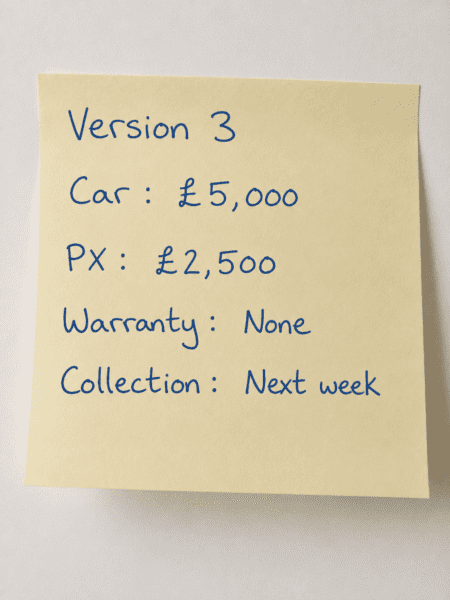
This is the first proper step to effectively capturing the negotiation deal.
Now the offer is not floating around as a number. It has context. You can see what is included.
How to Track the Deal as It Moves
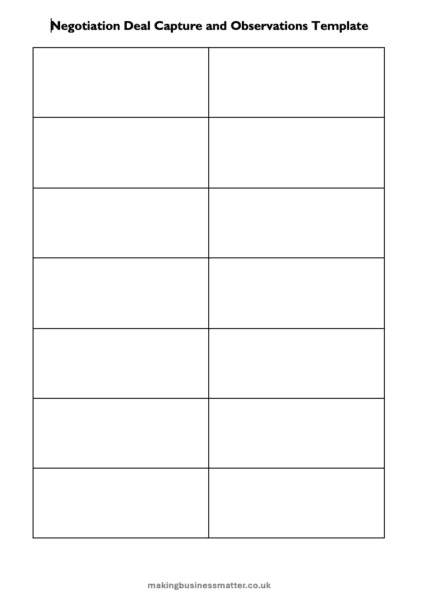
We have made a simple template for you to use. Once you know how to write the deal clearly, the next step is to track how it changes.
This does not need to be complicated. Each time the deal changes, write a new version and add the time.
That way, you can see the order of the negotiation without trying to remember it later.
Deal 1: The First Deal on the Table
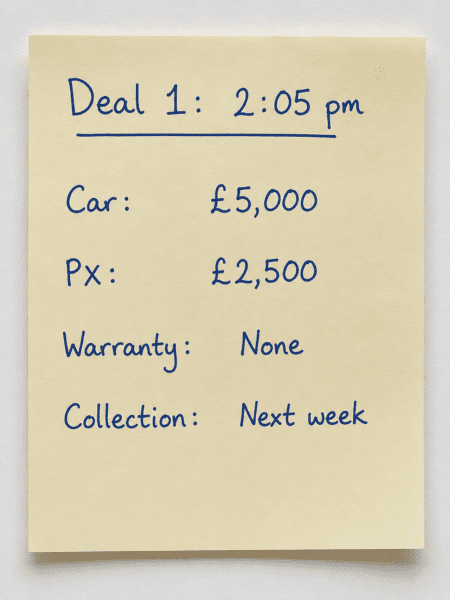
This is the starting point of your meeting notes.
It shows the first version of the deal clearly. It may not be the final deal, but it gives you something to work from.
Deal 2: The Deal Has Moved
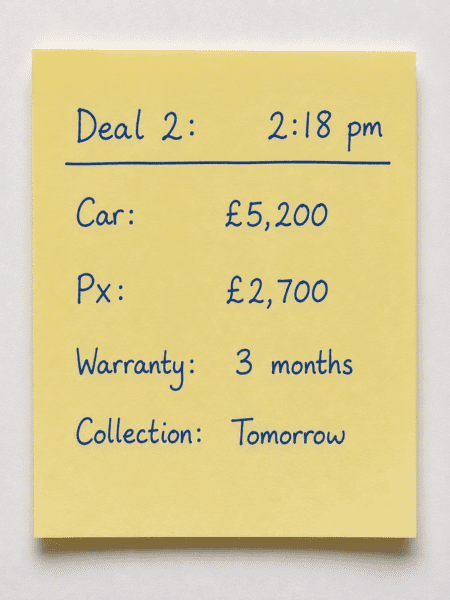
Now the deal has changed.
The car price has moved. The part exchange has moved. Warranty has been added. The collection has also changed.
This is why deal capture is useful. It helps you see the whole deal, not just one number.
If your meeting notes only say “£5,200,” you miss the fact that other parts of the deal improved too.
Deal 3: The Final Deal Before Closing
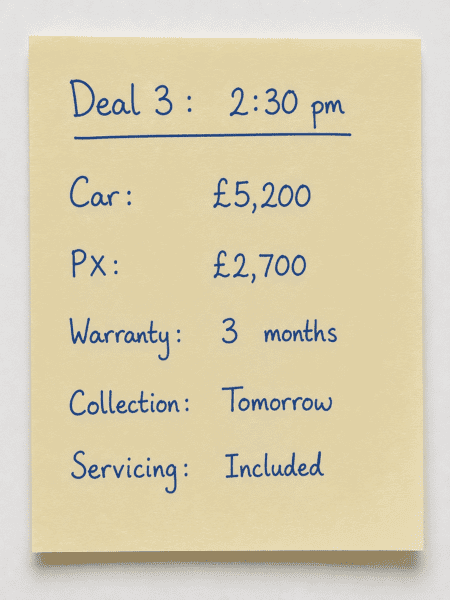
Now the deal has moved again.
The price has stayed the same, but servicing has been added. That matters because it adds value without changing the headline price.
This is the kind of detail people forget when they only write rough meeting notes.
A simple line like “Servicing: Included” protects the agreement.
The Simple Rule
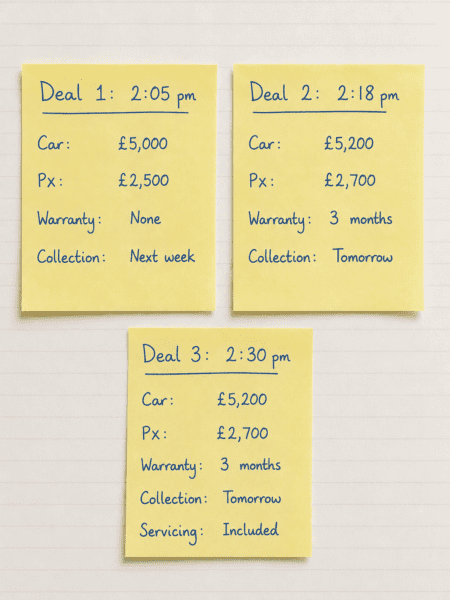
Every time the deal changes, write a new version.
Add the time.
Keep the old version readable.
Your notes do not need to be beautiful. They just need to show the deal as it moves.
That is the difference between normal meeting notes and deal capture.
Normal meeting notes help you remember the meeting. Deal capture helps you manage the negotiation while it is still happening.
The Split-Pad Method: The Advanced Method of Negotiation Note-Taking

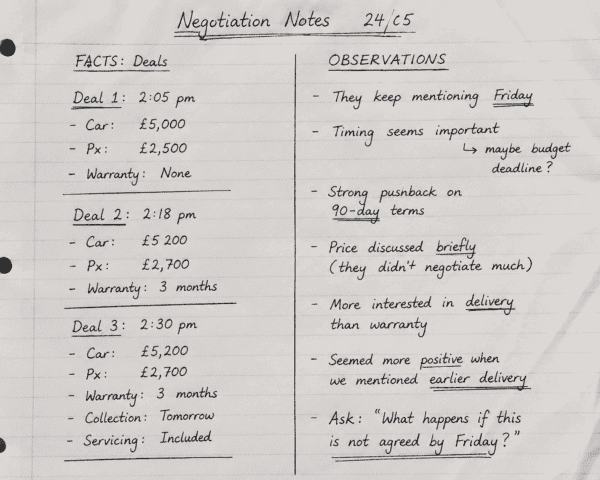
A simple fix is to split your page into two:
- One side is for facts.
- The other side is for thinking.
This is not complicated, and it does not need a fancy template for your meeting notes. You can draw one line down the middle of your notebook before the meeting starts.
Left Side: Capturing of the Deal (Facts)
The left side is for anything that was offered, agreed to, or discussed.
This is where you capture the deal as it stands and evolves.
Use this side to track the variables of the negotiation. For example, if a supplier says, “We can reduce the price by 5%, but only if you sign before Friday,” that belongs on the facts side.
It is not just a discount. It is a conditional discount.
Your meeting notes should show both parts.
- Price reduced by 5%
- Condition: Must sign before Friday
That small detail matters. Without it, someone may remember the discount but forget the condition attached to it.
Right Side: Observations
The right side is where you write what you notice while the negotiation is happening.
That could be:
- Pause after a price
- Repeated concern
- Phrase they keep using
- The topic they avoid
- Nervous laugh
- Change in tone
- Moment where they seem under pressure
- The point they come back to more than once
These clues often tell you more than the offer itself.
For example, imagine you offer a 5% discount. The other side barely reacts.
Then you mention moving delivery forward by two weeks, and suddenly they become more engaged.
That tells you something.
The negotiation may not be about price at all. It may be about timing.
Or perhaps they keep mentioning internal approvals, budgets, or deadlines. On the surface, they are discussing price. Underneath, they may be worried about getting the deal approved before the end of the quarter.
Research supports the importance of paying attention to these signals. Harvard’s Program on Negotiation highlights the value of active listening and understanding underlying interests rather than focusing only on stated positions. Skilled negotiators look beyond what people ask for and try to understand why they are asking for it.
That is why the observations side matters.
It helps you spot patterns, pressures, motivations, and concerns that may never be stated directly.
This matters because negotiation is not only about the numbers people say out loud. It is also about the clues around those numbers.
Listen for More Than the Numbers
Chris Voss, the former FBI hostage negotiator and author of Never Split the Difference, often teaches the value of mirroring and labelling in negotiation. His MasterClass page explains that mirroring can help negotiators gather useful information and put the other person at ease.
That matters here because good meeting notes should not only capture numbers. These details can show you what the other side may not be saying directly. And this is why the right-hand side of your pad containing observations is so important.
For example, if someone says, “The price is fine, but we just need to be careful with timing,” do not only write:
Price agreed.
Write:
- Price seems acceptable.
- Timing is the concern.
- Need to clarify the deadline.
That is a better deal capture.
Because in many negotiations, the most useful information is not always in the headline offer. It is in the hesitation, the pressure, and the small clues around it.
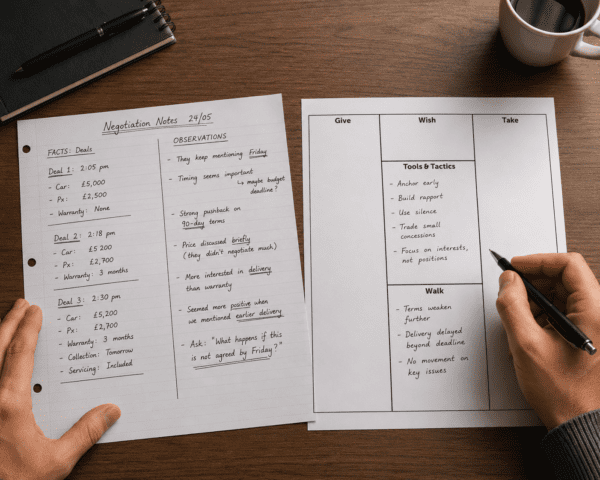
A Simple Split-Pad Example
If You Are Negotiating as a Team, Give the Notes a Role
Team negotiations can get messy very quickly. Sometimes everyone talks, but nobody tracks the deal. Other times, everyone is looking down at their own meeting notes, and the team loses eye contact with the other side.
Neither works well.
If you are negotiating as a team, note-taking should not be accidental. Someone needs to own the deal capture and own the observations.
A simple way to do this is to give each person a clear role before the meeting starts.
The Lead Negotiator
This person runs the conversation.
Their job is to ask questions, manage the tone, build trust, and keep the relationship strong. They should not also be trying to write every detail down.
The Deal Tracker
This person owns the meeting notes.
They capture offers, changes, conditions, concessions, and open points. Their job is to keep the deal visible as it moves. They also track any observations made throughout the meeting.
A Simple Negotiation Meeting Notes Template
If you want better meeting notes, do not start with a blank page.
Start with three stages:
- Before the meeting.
- During the meeting.
- After the meeting.
That sounds simple, but it changes how you think. You are no longer just writing things down as they happen. You are preparing, tracking, and then confirming the deal.
Before the Meeting: Know What You Are Looking For
At MBM, we help people prepare before negotiations, doing this using our own simple and exclusive tool: The Squaredance.
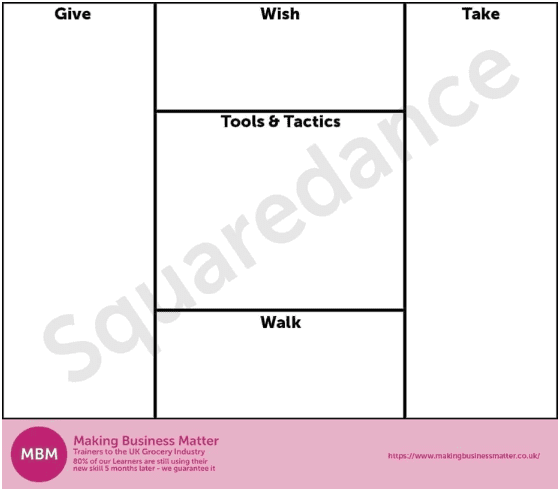
The Squaredance is a one-page negotiation template that helps you think through five key areas before you walk into the room:
- Your Give: What can you give, trade, or offer that may help move the deal forward?
- Your Wish: What do you want to achieve from this negotiation?
- Your Take: What do you want from the other side, beyond the obvious point of price?
- Your Tools & Tactics: Which negotiation tools will help you get the result you want?
- Your Walk: What is your walk-away point? What is the lowest or worst-case deal you will accept before you walk away?
In simple terms, the Squaredance helps you think about how you will win the negotiation before it starts.
It prompts you with the right questions. It helps you prepare your position. It also reminds you that the deal is not only about price.
But once the negotiation begins, the job changes.
Your Squaredance helps you prepare before the meeting. Your meeting notes help you track what happens during the meeting.
At the End of the Meeting: Summarise Before You Leave
This is the part many people miss. Do not wait until the follow-up email to work out what was agreed. Summarise the deal at the end of the negotiation, while everyone is still there.
You can say:
“Before we finish, can I check I have captured this correctly?”
Then confirm:
- What was agreed?
- What deadline has been agreed?
- What is still open?
- What needs confirming in writing?
- Who is doing what next?
- What is our next move?
This final summary is important because it gives everyone a chance to correct confusion before it becomes a problem.
After the meeting, send the same summary by email.
That email should not introduce a new version of the deal. It should simply confirm what was already summarised in the room. That is how meeting notes become more than admin. They become a record of the deal everyone agreed to.
Then, you move into Stage 5 – Implementation and begin delivering your agreed pieces and ensuring that the other party does the same.
How Deals Go Wrong When Nobody Captures Them Properly

Most negotiations do not fail because people are bad negotiators. They fail because people leave the room with different versions of what just happened and bad meeting notes.
- Someone forgets a condition.
- Someone assumes a point was agreed.
- Someone remembers a deadline differently.
- Someone sends a follow-up email that the other side disagrees with.
Now the negotiation has a new problem. Instead of discussing the deal, both sides are arguing about what was said.
Mistake 1: Assuming Everyone Heard the Same Thing
The Twitter acquisition is a useful reminder that wording matters.
In 2022, Elon Musk attempted to terminate his $44 billion agreement to acquire Twitter. Twitter argued that the agreement was binding and sued to enforce the deal. What followed was a highly public dispute over obligations, commitments, and the terms that had been agreed.
Most workplace negotiations will never end up in court. But smaller versions of the same problem happen every day.
- One person leaves believing the discount was agreed.
- The other believes it was only discussed.
- One person believes the deadline is fixed.
- The other thinks it is only a target.
That is why negotiators should never rely on memory.
At the end of a negotiation, the deal should be captured clearly, summarised clearly, and confirmed clearly.
Mistake 2: Failing to Track Open Issues
Long negotiations create a different problem. People forget what is still open.
The ongoing negotiations between Starbucks and Workers United involve multiple issues, including pay, scheduling, staffing, benefits, and working conditions.
When discussions stretch over weeks or months, it becomes difficult to remember exactly where each issue stands.
Without clear tracking, teams can waste time reopening conversations they thought were settled.
This is why experienced negotiators track issues individually.
For each issue, they record:
- What each side wants
- What has been offered
- What has been agreed
- What remains open
- Who owns the next action
The longer the negotiation, the more valuable this becomes.
Mistake 3: Treating Meeting Notes Like Administrative Duties, Not Evidence
A useful case here is Malcolm Charles Contracts Ltd v Crispin.
This was a construction dispute. The parties had a pre-contract meeting about building works. Later, there was a dispute about whether a binding agreement had actually been reached.
The court looked closely at the meeting notes minutes.
Those minutes recorded the key parts of the deal, including the scope of the work, the start and finish dates, the contract sum, and how payment would work. The judge held that the meeting had resulted in a binding agreement and that the minutes accurately showed the agreed terms.
The court acknowledged that since the parties carried out lengthy negotiations the court must “look at the whole correspondence and decide whether, on its true construction, the parties had agreed to the same terms” and that if the court was wrong on the above conclusion, then, in the alternative, a binding agreement on the JCT HOO terms was concluded upon the handing over of keys to MCC on 7 September 2011. Accordingly, the court held that the adjudicator had jurisdiction and his decision was upheld.
That is the point.
The notes did not just say:
“Building works discussed.”
They captured the deal.
They showed in their meeting notes what work was included, when it would happen, what it would cost, and how payment would work.
In everyday negotiations, this is the difference between weak meeting notes and useful meeting notes.
Final Thought
Good meeting notes are not about writing more. They are about seeing the deal more clearly.
In a negotiation, every offer, condition, concession, and open point matters. If your notes only capture random details, you may leave the room with a version of the deal that nobody else fully agrees with.
That is why deal capture matters.
It helps you track what changed, protect what was agreed, and spot what still needs work.
So next time you go into a negotiation, do not just take meeting notes.
Capture the deal.