
The Hidden Power Behind How Leaders Win Hearts and Minds
When great leaders speak, people not only listen, but also take action. They feel something. It is not luck or charm. It is a skill that has existed for over 2,000 years. Aristotle called it Ethos, Pathos, Logos. Ethos means trust. Pathos means emotion. Logos means logic. Together, Ethos, Pathos, Logos turn simple words into real action. These three forces form the foundation of every message that moves people to believe, follow, and act.
I have noticed that many leaders still believe logic alone can win people over. But in my experience, logic is only heard when trust and emotion come first.
Think of Jacinda Ardern, who led her country with empathy. Think of Satya Nadella, who rebuilt Microsoft with compassion and clarity. Think of Patagonia’s founder, who turned his values into a movement that protects the planet. Each of them used Ethos, Pathos, Logos in their own way, and people followed them because they felt both trust and purpose.
In this article, we will explore how Ethos, Pathos, Logos still shape leadership today. You will see real examples of how Ethos, Pathos, Logos create trust, emotion, and logic in action. You will also learn how to use them in your own workplace to connect with others, build trust, and lead with both heart and reason.
Because facts make people think, but feelings make them move.
Why Aristotle Still Runs the Boardroom
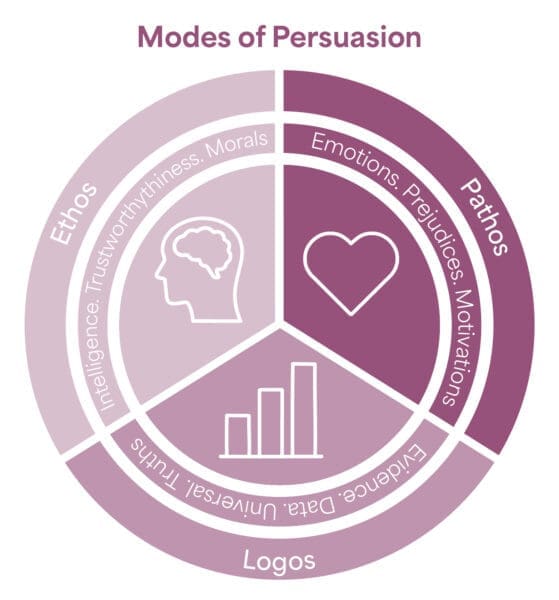
Aristotle lived more than two thousand years ago, yet Ethos, Pathos, Logos remain the backbone of every persuasive leader today. Every speech, sales pitch, and company vision still depends on the same three forces: Ethos, Pathos, Logos.
In business, we like to think that logic wins. We trust numbers, data, and charts. But research shows something different. According to a 2023 Harvard Business Review study, leaders who combine emotion with logic are over 70% more effective at inspiring action than those who rely only on facts. People may understand your numbers, but they will only act when they also feel connected to your message.
Ethos (from the Greek ēthos, meaning “character”) means credibility or trust. It is about who you are and why people should believe you. When a leader shows honesty, values, and experience, people listen. Ethos answers the question, “Can I trust you?”
Pathos (from the Greek pathos, meaning “emotion” or “suffering”) means emotion. It touches how people feel about your message. It is the story that makes your vision come alive. When a leader speaks with empathy or passion, people feel seen and understood. Pathos answers the question, “Do I care?”
Logos (from the Greek logos, meaning “reason” or “word”) means logic. It speaks to reason and facts. It gives your message structure, proof, and sense. When a leader explains the “why” behind a decision with clarity, people understand and follow. Logos answers the question, “Does this make sense?”
That is why the most successful leaders mix all three: Ethos, Pathos, Logos. Ethos builds trust by showing who you are and what you stand for. Pathos builds connection by showing that you care and understand what others feel. Logos builds clarity by explaining the reason behind your message. When they work together, your words move both hearts and minds.
In the modern boardroom, Ethos, Pathos, Logos are more than philosophy. They are a leadership framework for every conversation, presentation, and decision that demands persuasion.
Pathos: The Forgotten Superpower
Pathos is the power of emotion, the part of Ethos, Pathos, Logos that makes people feel something when you speak. You can have the best idea in the room, but if it does not move anyone, it will not matter. What I find fascinating is that we live in a time when leaders have more channels than ever to speak, yet their words often feel less human. Technology amplifies Logos, slides, charts, dashboards, but it can quietly drain Pathos. I think the leaders who thrive today are the ones who put humanity back into their logic.
Why Emotion Still Matters
In business, we often try to sound smart, not human. We fill slides with numbers and emails with careful words. But people do not follow data. They follow emotion. When leaders use Pathos well, they turn information into inspiration.
A 2022 Gallup report found that employees who feel emotionally connected to their leaders are four times more likely to be engaged at work. That means emotion is not only about feelings. It directly shapes performance, trust, and loyalty. It’s the heartbeat of the Ethos, Pathos, Logos triangle, connecting human emotion with rational purpose.
Our Sticky Learning ® method is 7x more effective than 1-day training courses. Plus, we deliver a Chain of Evidence report proving your Return on Investment. Discover Soft Skills Training that changes behaviours long-term.

Leaders Who Lead With Heart
Jacinda Ardern showed this when she led New Zealand through a crisis. After the Christchurch attacks, she did not start with policy or plans. She started with care. She spoke with warmth and grief. Her honesty and empathy brought comfort to a country in pain. Her empathy reflected true leadership rooted in ethos, pathos, logos: emotional honesty, personal integrity, and clarity of action.
Satya Nadella also used Pathos when he became CEO of Microsoft. He shared a story about his son, who was born with special needs. That story showed what empathy meant to him. He used that lesson to reshape Microsoft’s culture around curiosity and kindness. The result was more trust, more teamwork, and more innovation.
Patagonia’s founder, Yvon Chouinard, used Pathos differently. He turned his values into his brand. Every campaign told a story about care for the planet. For example, Patagonia’s 2011 “Don’t Buy This Jacket” campaign shocked consumers by urging them not to purchase unless they truly needed it, highlighting the environmental cost of fast fashion. Instead of pushing sales, it sparked reflection and trust. When he later gave away his company to fight climate change, people believed him because his ethos, pathos, logos had always aligned.
How to Use Pathos in Everyday Work
Pathos does not mean acting dramatically or pretending to care. It means showing your real human side. It is when a leader says, “I understand how this feels” before talking about change. It is when a teammate shares a story that others relate to. It is when you turn numbers into stories that people can see and feel.
If you want to use Pathos well, start small:
- Listen first. Notice how people feel, not only what they say.
- Tell one true story. It does not need to be perfect, only real.
- Speak with warmth. Your tone and body language say more than words.
- Use simple emotional words. Words like hope, courage, or care connect better than strategy or metrics.
Mastering Pathos keeps your Ethos, Pathos, Logos balance alive. Emotion opens the door for logic to enter.
Ethos: The Credibility Gap
Ethos is the foundation of the Ethos, Pathos, Logos framework, the part that builds trust before you even speak. It is what makes people believe you before they even hear your full message. Without trust, no amount of logic or emotion will matter. To me, Ethos today is less about titles and more about consistency. People trust leaders who show up the same way on a good day and on a bad one.
What Ethos Really Means
Ethos means credibility. It comes from the word “ethics,” which reminds us that people follow those who are honest and consistent. In leadership, Ethos is not just about job titles or experience. It is about showing values through actions.
When leaders live the message they share, people believe them. When their words and actions match, teams feel safe to follow. Ethos answers the question that everyone quietly asks: Can I trust you?
Why Credibility Matters More Than Ever
Trust has become rare in the workplace, and Ethos, Pathos, Logos can help in that. A 2024 Edelman Trust Barometer found that only 61% of employees trust their company’s leadership. That number drops even lower when leaders fail to act in line with their values.
This “credibility gap” hurts motivation and loyalty. When people stop trusting leadership, they stop giving their best. On the other hand, when they believe in their leaders, they become more engaged, creative, and proud of their work.
Leaders Who Build Ethos Through Action
Tim Cook, the CEO of Apple, is a strong example of Ethos in modern leadership. He does not lead through big speeches or emotional stories. He leads through consistency. Cook speaks openly about privacy, equality, and sustainability, and Apple’s actions reflect those values. People believe him because he practices what he preaches. His Ethos, Pathos, Logos mix keeps ambition credible.
Indra Nooyi, former CEO of PepsiCo, is another example. She built her credibility by linking profit with purpose. Her strategy, called “Performance with Purpose,” showed that good business could also do good for society. She spoke about care and accountability, and people trusted her because her results matched her words.
Mary Barra, CEO of General Motors, also built trust by being transparent during crises. When she took charge in 2014, GM was under fire for a faulty ignition switch linked to several fatal accidents. Instead of deflecting blame, Barra publicly apologized, met with victims’ families, and initiated a full internal review. Her honesty during congressional hearings, where she admitted the company’s cultural failures, marked a turning point. By choosing transparency over damage control, she not only rebuilt GM’s reputation but earned lasting credibility as a leader who puts integrity above image.
How to Strengthen Your Ethos
Building Ethos takes time, but small actions make a big difference.
- Be consistent. Keep your word even in small things.
- Show humility. Admit when you do not know something. It builds respect, not weakness.
- Align words and actions. Do what you say you will do.
- Communicate your values clearly. Let people know what guides your decisions.
Trust grows slowly, but it disappears fast. That is why Ethos is the quiet backbone of leadership. It holds everything else together.
Logos: The Invisible Backbone
Logos is the power of logic. It is what gives your message structure and sense. Without it, emotion has no direction, and trust has no proof. That is why each element in Ethos, Pathos, logos is important.
What Logos Really Means
Logos comes from the Greek for “reason” or “word.” It’s the logical foundation of communication, the part that answers, Does this make sense? In leadership, logos is what transforms inspiration into execution, giving ethos, pathos, logos real-world impact.
A strong message needs emotion to connect and trust to persuade, but it also needs logic to hold everything together. Logos is the invisible backbone that supports Ethos and Pathos.
Why Logic Still Matters
In today’s world, information moves fast, and attention is short. People are more likely to believe a message when it feels clear and well-reasoned. According to a 2023 McKinsey survey, leaders who explain the “why” behind their decisions improve team alignment by 47%.
This shows that data and logic are not just nice to have. They help people understand the bigger picture. When employees see the reason behind a goal, they are more likely to support it and stay motivated.
Leaders Who Use Logos to Lead
Elon Musk often uses Logos in his communication, even when his style is bold. When he speaks about space or electric cars, he breaks big ideas into simple logic. He talks about the cost of energy, the limits of fossil fuels, and the math behind rocket reusability. His clear reasoning helps people believe that his impossible goals can actually happen.
Jeff Bezos used Logos at Amazon through written memos instead of PowerPoint slides. Every idea had to be shared in a six-page narrative. This forced teams to think clearly and logically structure their ideas. It created a culture where decisions were based on reason, not emotion alone.
Mary Barra, CEO of General Motors, also uses Logos to explain transformation. When she talks about the company’s shift to electric vehicles, she supports her message with clear goals, data, and timelines. Her logic helps employees and investors see the path forward instead of feeling lost in change.
How to Use Logos in Your Communication
You can make Logos part of every message by doing a few simple things:
- Explain the “why.” Reason fuels the full circle of ethos, pathos, logos.
- Use a clear structure. Start with the main point, then give evidence, and end with the action.
- Keep it simple. Avoid heavy terms and long sentences. Clarity is more powerful than complexity.
- Back up your ideas. Use real numbers, facts, or examples to support your message.
Putting It All Together: The Persuasive Trinity Framework

Most people can talk, but few can truly persuade. A 2023 McKinsey study showed that when leaders explain the “why” behind a change and connect it to shared values, team alignment improves by almost fifty per cent. That is the ethos, pathos, logos trinity in motion: trust, feeling, and reason.
The Natural Flow of Persuasion
Most leaders use ethos, pathos, logos, but not always in the right order. Many begin with data instead of trust. Others start with emotion but skip the facts. The most effective communicators follow a natural rhythm.
- Begin with Ethos. Show who you are and why this message matters to you.
- Move into Pathos. Show why it matters to your audience.
- End with Logos. Explain what should happen next and why it makes sense.
You can use this as a simple, three-part sentence model that captures ethos, pathos, logos in one breath
“As someone with [Ethos: credibility or experience], I understand how [Pathos: shared feeling or concern] affects us. That is why [Logos: logical action or solution] is the best next step.”
It works because it connects personal credibility, shared emotion, and reason in one breath.
Example in action:
“As someone who has worked closely with start-up teams for years (Ethos), I know how discouraging it feels to see bold ideas get lost in process (Pathos). That is why creating a fast-track decision channel will help ideas grow and show results faster (Logos).”
This flow mirrors how people make decisions. We trust first, feel next, and think last. When your message follows that pattern, it sounds real and makes people want to act.
Howard Schultz and the Heart Behind Starbucks
When Howard Schultz returned as CEO of Starbucks in 2008, the company was losing direction. He began his comeback message with Ethos, speaking as someone who had grown up in a poor family and knew what community meant. Then came Pathos. He talked about the smell of coffee shops, the sound of baristas calling names, and the joy of small daily connections. Only then did he move to Logos, explaining how new standards, training, and store designs would restore quality.
What stands out is how Schultz used all three appeals: ethos, pathos, logos in perfect balance. In a world where many leaders hide emotion behind metrics, he built profit through purpose. What I like about Schultz’s style is that he never separates business goals from human stories. In a world where leaders often hide emotion behind metrics, he built profit through purpose. I sometimes wonder how many leaders today could do the same without a script.
Reed Hastings and the Logic of Trust
At Netflix, founder Reed Hastings used the same pattern to build a culture of freedom and responsibility. His Ethos came from credibility. He had led the company from DVDs to streaming and earned the right to speak about innovation. His Pathos came from understanding what creative people need to thrive: trust and space. Then came Logos. He showed that when employees are trusted to make decisions, results improve and innovation speeds up.
That combination of ethos, pathos, logos reshaped Netflix into one of the most adaptive and creative workplaces in the world.
Brené Brown and the Power of Honest Emotion
Researcher Brené Brown built her influence through a different route. She began with Ethos, sharing her years of study on vulnerability and leadership. Then she opened the door to Pathos by telling her own stories of shame, fear, and courage. She connected emotionally before moving to Logos, explaining how vulnerability leads to stronger teams and better problem-solving.
Her talks and books reached millions because she balanced and combined all aspects of ethos, pathos, logos. She turned research into something deeply human.
Bob Iger and the Clarity of Vision
When Bob Iger became CEO of Disney, the company was struggling to grow. He started with Ethos, sharing his belief in creativity and respect for the brand’s legacy. Then came Pathos, as he spoke about how stories shape childhood memories across generations. Finally, he used Logos to explain clear steps: acquire Pixar, Marvel, and Lucasfilm to bring new worlds into Disney’s future.
Iger’s exceptional trait is how naturally he blends ethos, pathos, logos. What I love about Iger’s method is his ability to speak in a way that feels personal, even when his audience is the whole world. I think this balance, between humility and scale, is the ultimate test of communication today.
How to Use the Persuasive Trinity in Everyday Leadership

Knowing about Ethos, Pathos, Logos is one thing. Using them is what turns theory into leadership. Every message you share, whether it is a meeting, an email, a pitch, or a moment of feedback, is a chance to use this balance of trust, emotion, and logic.
Below are five powerful ways to apply Ethos, Pathos, Logos every day.
1. In Team Meetings: Lead With Trust and Clarity
Start every meeting by showing your Ethos. Show that you respect people’s time and effort. Then connect emotionally through Pathos. Name what the team might be feeling, such as pressure, pride, or uncertainty. End with Logos, a clear plan that makes sense.
Example:
“I know this week has been long, and everyone has been doing extra work. I really appreciate it. I also know the new process feels confusing. Here is how it will save us time once it is fully in place.”
This Ethos, Pathos, Logos structure makes your words warm, credible, and practical in one short message.
2. In Feedback or Difficult Conversations: Build Before You Correct
When giving feedback, many leaders jump straight to Logos, explaining what went wrong. That can sound cold or harsh. Instead, begin with Ethos and Pathos. Start with trust, then show empathy. Only then explain your reasoning. In feedback, I’ve seen that the moment you show understanding, tension drops. People open up because they feel seen, not judged.
Example:
“You always bring creative ideas, and your presentations are full of energy. I know this last one did not land how you hoped. Let us tighten the story so your best ideas come through more clearly next time.”
This Ethos, Pathos, Logos order turns correction into coaching and builds connection before critique.
3. In Written Communication: Make Every Email Count
Even short messages can use all three elements.
- Ethos: Begin with honesty or appreciation.
- Pathos: Add one line that connects on a human level.
- Logos: End with the facts or next steps.
Example:
“Hi team, thank you for handling yesterday’s client issue so calmly (Ethos: builds credibility and respect by acknowledging professionalism). I know it was stressful (Pathos: shows empathy and emotional understanding). Here is the follow-up plan and who will lead each step (Logos: provides logical structure and clarity).”
A few lines that include Ethos, Pathos, Logos can build credibility, connection, and clarity at once.
4. In Motivation and Vision Talks: Tell a Story Before You Share a Plan
When you want to inspire people, start with emotion, not metrics. Use Pathos to tell a simple, true story. Then bring in Ethos by connecting it to your values. Finish with Logos through a clear action plan.
Example:
“Last month, a customer said our quick help turned their business launch around. That story reminds me why teamwork matters here. To keep that level of care, we will start short daily check-ins to solve issues faster.”
Stories powered by Ethos, Pathos, Logos make your message memorable and authentic, emotion builds attention, and logic sustains belief.
5. In Change and Uncertainty: Speak to Feelings Before Facts
Change always brings emotion first. Begin with Pathos by naming that emotion. Use Ethos to remind people of shared goals or values. End with Logos by giving clear steps forward.
Example:
“I know this reorganisation feels hard. I have been through it before, and I remember that feeling. But we believe in growth and opportunity. This plan will open new roles and help us move faster.”
By consciously applying Ethos, Pathos, Logos, leaders can calm anxiety, build unity, and guide people through change with confidence.
The Takeaway
Every time you speak or write, ask three questions.
- Have I earned trust?
- Have I touched emotion?
- Have I made the logic clear?
If the answer is yes to all three, you are leading with Ethos, Pathos, Logos in balance. That is what makes communication both human and effective.
Conclusion: The Human Side of Persuasion
Leadership is not about having the loudest voice. It is about creating trust, emotion, and understanding in the same breath. Ethos, Pathos, Logos are not just ideas from philosophy. They are tools for modern leaders who want to speak with impact and lead with heart.
When you use all three, you do more than share information. You build belief. You help people see meaning in their work and feel part of something larger than themselves.
Facts make people think. Feelings make them move. Trust makes them stay.
I believe the future of leadership will belong to those who can make reason feel human. We have enough data. What we need now are leaders who can speak to the heart without losing their head.